






Government and Foundational Infrastructure
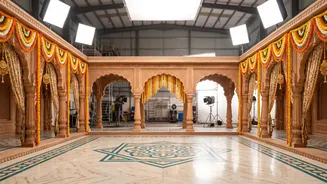
The Maharashtra state government has historically played a crucial role in nurturing the Hindi film industry. The most visible symbol of this is the Dadasaheb Phalke Chitranagari, better known as Film City, established in Goregaon in 1977. This sprawling
520-acre complex provides a one-stop solution for filmmakers, offering everything from sound stages and recording studios to permanent sets like temples, courts, and villages. This infrastructure significantly reduces logistical hurdles and costs for production houses. More recently, the state government has focused on modernizing its support systems. Efforts are underway to introduce a single-window clearance system for shooting permissions, moving the process online to improve efficiency. There are also plans to develop new filming hubs across Maharashtra, including in locations like Kolhapur, Nashik, and Ramtek, to expand infrastructure beyond Mumbai. In May 2026, a committee was formed to propose new incentive-driven policies and subsidies to ensure Maharashtra remains a top filming destination.
The Power of Industry Associations
Bollywood is not just a collection of production houses; it's a highly organized sector governed by powerful guilds and associations that protect workers' rights and set industry standards. Bodies like the Federation of Western India Cine Employees (FWICE) and the All Indian Cine Workers Association (AICWA) act as trade unions for technicians, artists, and other workers. They advocate for fair wages, safe working conditions, and provide a platform for grievance redressal. For directors, the Indian Film & Television Directors' Association (IFTDA) is a mandatory body that supports its members with dispute resolution and professional development workshops. On the business side, the Producers Guild of India represents the interests of film, television, and digital content producers, liaising with the government on policy, taxation, and copyright protection. These organizations create a framework of rules and protections that bring order to a creatively chaotic industry, ensuring its long-term stability and the welfare of its members.
Finance, Corporatization, and Private Enterprise
For decades, film financing was a notoriously informal and high-risk affair. However, the game changed in 2000 when the government granted Bollywood official 'industry status'. This pivotal decision opened the doors for formal financing from banks, financial institutions, and foreign direct investment. Today, the industry is a mix of traditional family-run production houses and large, corporatized studios like Yash Raj Films and Dharma Productions. These major players have diversified into distribution, talent management, and merchandising, creating a more stable economic model. This professionalization has brought greater transparency and accountability to film financing, moving it away from its once-shadowy origins and integrating it into India's formal economy. The rise of venture capital and private equity has further fueled this growth, allowing for bigger budgets and more ambitious projects.
The Unsung Ancillary Economy
Perhaps the most critical support system is the vast, often informal, network of ancillary businesses that thrives around the film industry. For every star on screen, there are thousands of people working behind the scenes in jobs that are essential but rarely celebrated. This includes caterers providing meals on set, costume suppliers, set decorators, lighting technicians, drivers, and countless other vendors. Mumbai's unique urban fabric, with its dense network of suppliers and skilled labor, allows a film production to source almost anything it needs at a moment's notice. This ecosystem extends to post-production facilities for editing, sound mixing, and visual effects, many of which are world-class. This deep-rooted network of interdependent businesses and skilled artisans is the lifeblood of Bollywood, providing the flexibility, speed, and workforce necessary to produce hundreds of films each year.