








The Ultimate Safety Net
Before India sends its astronauts, or ‘Gaganauts’, into orbit, it must first guarantee their safe return. This is the single most critical aspect of human spaceflight. After the Gaganyaan crew module re-enters Earth’s atmosphere at incredible speeds,
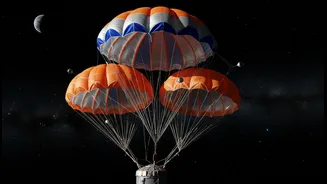
its journey ends with a gentle splashdown in the ocean. Making this possible is a complex, multi-stage parachute system, the ultimate safety net. This system doesn’t just involve one large parachute; it’s a meticulously choreographed sequence. The Gaganyaan system uses a total of ten parachutes of four different types to slow the module from hypersonic speeds to a gentle landing velocity. It starts with smaller drogue parachutes that stabilize the capsule, followed by pilot parachutes that pull out the three massive main parachutes. Failure at any stage is not an option when human lives are on the line.
Success Under Pressure
ISRO, in collaboration with DRDO, recently conducted a crucial Integrated Main Parachute Airdrop Test (IMAT). In the test, a payload simulating the crew module's weight was dropped from an Indian Air Force IL-76 aircraft at an altitude of 2.5 kilometres. This was the fifth such integrated test, designed to qualify the main parachutes under the maximum load conditions they would face during the first uncrewed mission. The successful deployment and performance provide ISRO with the confidence and validated data needed to proceed. These tests aren't simple pass/fail events; they are rigorous qualifications that demonstrate the system’s reliability and structural integrity, proving that the designs work not just in theory, but in practice.
The Currency of Credibility
So, how does a parachute test in Madhya Pradesh translate to international confidence? In the world of space exploration, capability is demonstrated, not just declared. Every successful test of a mission-critical system, especially one directly tied to crew safety, is a verifiable data point that showcases a nation's technical maturity. When ISRO successfully qualifies its parachute system, it sends a clear signal to the international space community: India is methodical, safety-conscious, and has the engineering prowess to manage the immense risks of human spaceflight. This builds credibility in a way that speeches and mission announcements cannot. It's the technical proof that underpins diplomatic promises.
Strengthening Global Partnerships
The Gaganyaan mission is already a collaborative effort. India is working with Russia for astronaut training and with France on space medicine and life support systems. More recently, the European Space Agency (ESA) signed a major agreement to provide crucial ground station tracking support for the missions. These partnerships are built on mutual trust. When partners like ESA see ISRO meticulously testing and validating critical systems, it reinforces their confidence in the mission's viability and in India as a reliable partner. Demonstrating this level of domestic capability makes India a more attractive collaborator for future ambitious projects, whether it's missions to the Moon, Mars, or a future Indian space station.
A Stepping Stone to the Stars
Ultimately, the parachute tests are about more than just one mission. They are a fundamental building block for India’s entire human spaceflight ambition. By mastering these complex systems, ISRO is not just preparing for Gaganyaan; it is developing an ecosystem of technologies and expertise that will serve the nation for decades. It signals that India is not just aiming to join the elite club of space-faring nations that can send humans to orbit, but to do so with a focus on safety and reliability that commands international respect. Each successful test is another step solidifying India’s position as a serious, capable, and trustworthy player in the final frontier.