



A Calendar Gone Wrong
On Earth, our sense of time is straightforward: one day is one rotation of the planet on its axis (24 hours), and one year is one orbit around the Sun (365.25 days). This rhythm governs our lives. On Venus, this fundamental relationship is turned completely
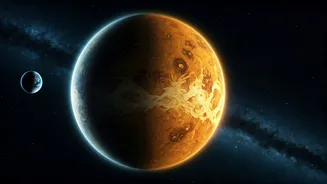
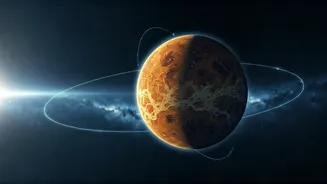
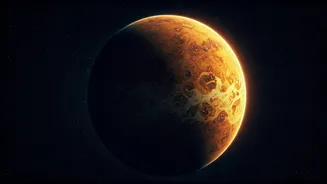
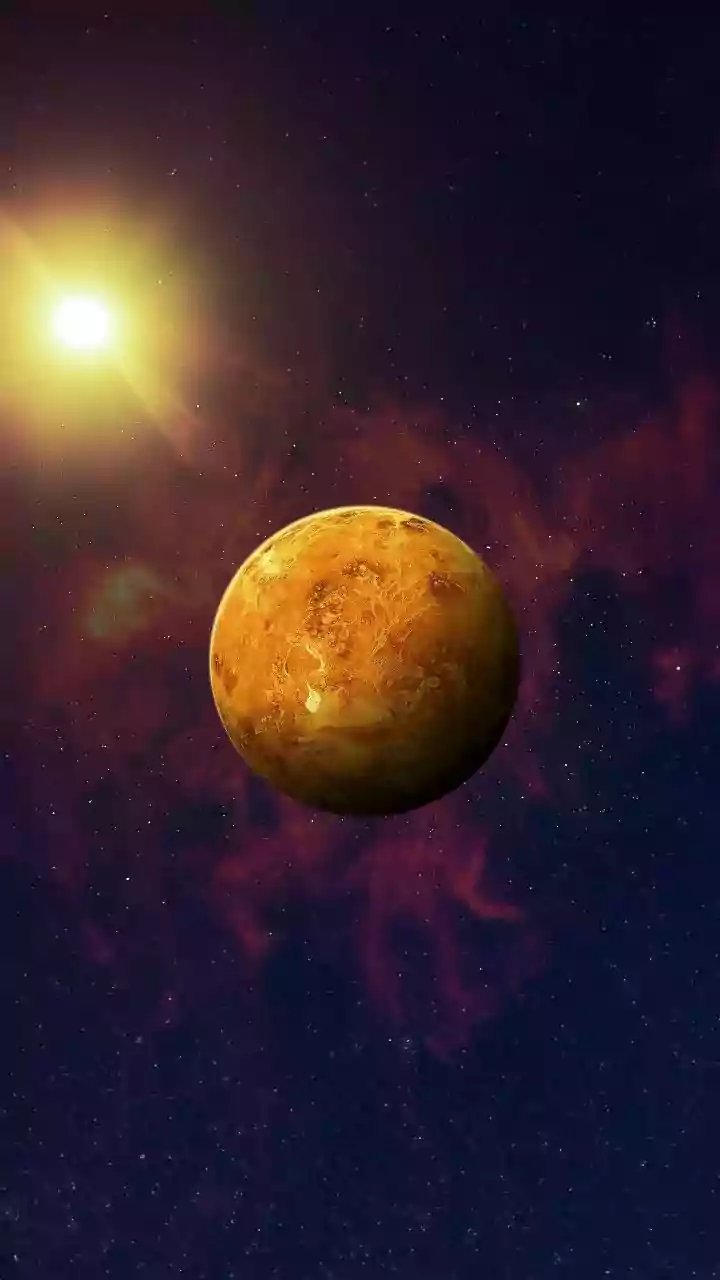
upside down. A year on Venus—the time it takes to complete one full orbit around the Sun—is about 225 Earth days. However, a single day on Venus—the time it takes for the planet to spin once on its axis—is a mind-boggling 243 Earth days. That’s right: a Venusian day is 18 Earth days longer than a Venusian year. If you lived on Venus, you could celebrate your first birthday before you’d even lived through your first full day. This counterintuitive fact makes Venus one of the most peculiar places in our solar system.
Rotation Versus Revolution
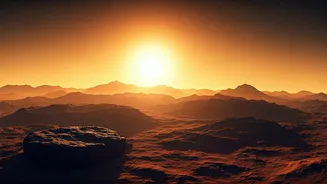
To understand this paradox, we need to be clear about two different motions: rotation and revolution. Revolution is a planet’s journey around the Sun, which defines its year. Rotation is the planet’s spin on its own axis, which defines its day. Most planets in our solar system, including Earth, spin relatively quickly and in the same direction they orbit the Sun (prograde). Venus does the opposite. Firstly, it spins incredibly slowly. A single rotation takes longer than its entire journey around the Sun. Secondly, it spins backwards, or in 'retrograde' motion. If you could stand on the surface of Venus (and survive its crushing pressure and scorching heat), you would see the Sun rise in the west and set in the east. This combination of an extremely slow spin and retrograde motion is the key to its bizarre timekeeping.
A Planet Braked by Its Sky
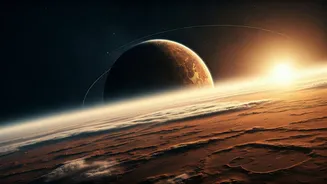
So, why is Venus’s rotation so sluggish? Scientists believe the primary culprit is its own atmosphere. The Venusian atmosphere is a monster—over 90 times denser than Earth’s and composed almost entirely of carbon dioxide. This creates an extreme greenhouse effect, with surface temperatures hot enough to melt lead. This thick, heavy atmosphere is in constant, rapid motion, with winds in the upper atmosphere reaching speeds of over 360 km/h. This super-rotating atmosphere doesn't just sit there; it physically drags on the planet's surface. Over billions of years, this constant friction between the fast-moving sky and the solid planet below has acted like a powerful brake, slowing Venus’s rotation down to its current crawl. It’s a case of the tail wagging the dog, where the atmosphere dictates the spin of the entire planet.
An Ancient Cosmic Collision?
The slow spin is one mystery, but the backward spin is another. Why does Venus rotate in the opposite direction to most other planets? The leading theory points to a violent past. Early in the solar system's history, the space between planets was a chaotic shooting gallery of large celestial bodies. It's possible that a massive planet-sized object, or perhaps a series of large asteroids, collided with a young Venus. Such a catastrophic impact could have been powerful enough to not just alter its spin but to effectively knock it upside down or reverse its rotation entirely. Another, more recent theory suggests that the powerful atmospheric braking didn't just slow Venus down, but it slowed it to a near standstill, and the continued gravitational and tidal tug-of-war between the Sun and its thick atmosphere eventually nudged it into a slow, stable retrograde spin. The true answer is likely a combination of these powerful forces over billions of years.
What This Means for Venus
This strange timing has profound consequences for the planet. With one side facing the Sun for months at a time, and the other plunged into an equally long night, you might expect extreme temperature differences. However, the thick, fast-moving atmosphere is incredibly efficient at distributing heat. It acts like a global blanket, ensuring the night side is just as hellishly hot as the day side. The long day and scorching heat, combined with crushing atmospheric pressure, make Venus one of the most inhospitable environments imaginable. It’s a world where time itself is alien, a stark reminder of the diverse and often violent processes that shape the planets in our cosmic neighbourhood.