

A New Eye on the Cosmos
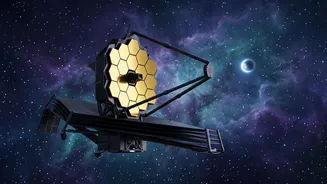
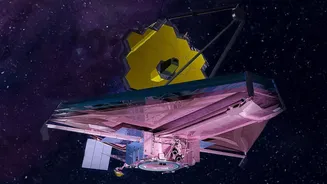
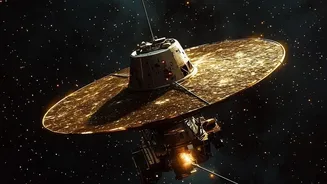
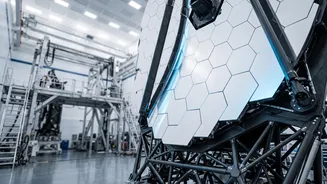
The James Webb Space Telescope is the most powerful and complex space observatory ever built. A joint mission from NASA, the European Space Agency (ESA), and the Canadian Space Agency, its massive golden mirror and advanced infrared instruments allow
it to see farther and with greater clarity than any telescope before it. While the Hubble Space Telescope gave us iconic images of the universe, JWST is designed to see the universe in a different light—infrared. This allows it to pierce through cosmic dust clouds that obscure the vision of other telescopes, giving scientists a front-row seat to the formation of stars and planets.
Peering into a Cosmic Construction Site
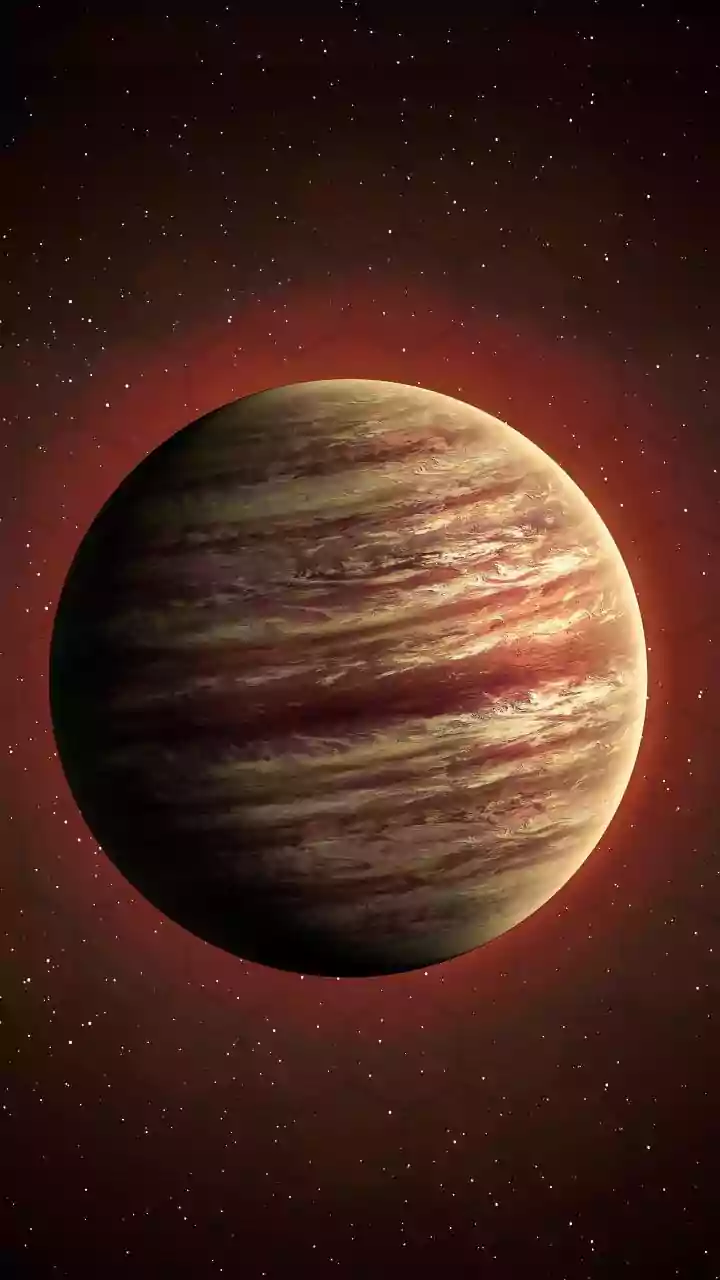
To learn more about how planets are made, astronomers pointed Webb toward a star system called PDS 70, located about 370 light-years from Earth. PDS 70 is a young star, only about 5.4 million years old, surrounded by a vast, rotating disc of gas and dust known as a protoplanetary disk. These disks are essentially the leftover material from a star's formation, and they are the cosmic construction sites where planets are built. The PDS 70 system is particularly interesting because it has a large gap in its disk, where astronomers have already confirmed the existence of two large, Jupiter-like planets that are actively growing.
The Discovery of Water Vapor
In a groundbreaking discovery, Webb's Mid-Infrared Instrument (MIRI) detected the chemical signature of water vapor in the inner part of the PDS 70 disk. This is the first time water has been found in the terrestrial zone—the region where rocky, Earth-like planets are expected to form—of a disk that is already known to host planets. The water was detected less than 160 million kilometers from the star, a distance comparable to Earth's orbit around our Sun. According to Giulia Perotti of the Max Planck Institute for Astronomy, scientists have seen water in other disks, but never this close to the star in a system where planets are actively assembling. This was a measurement that simply wasn't possible before the capabilities of the JWST.
Why This Finding is So Exciting
Finding water is always a significant event in astronomy, but finding it here has profound implications. One of the biggest debates in planetary science is how Earth got its water. Did it form with its water already present, or was water delivered later by icy comets and asteroids from the outer solar system? The detection of water vapor in the planet-forming zone of PDS 70 suggests that rocky planets can have access to water from the very beginning of their formation. This means worlds like our own could be born with this essential ingredient for life already in place. The discovery was surprising because it was thought that the star's radiation would have blown away most of the gas and dust from this inner region by now.
The Building Blocks of Worlds
In addition to water, astronomers also observed the raw materials needed to build rocky worlds in the inner disk of PDS 70, specifically in the form of silicates. The combination of water vapor and a high amount of small dust grains makes this region an incredibly exciting place for scientists studying planetary formation. The findings from PDS 70 serve as a valuable model for understanding the early days of our own solar system. It's like looking at a family photo of our solar system when it was just a toddler, providing a real-world example of the processes that likely led to the formation of Earth over 4.5 billion years ago.