



A Planet of Geometric Storms
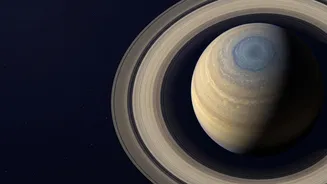
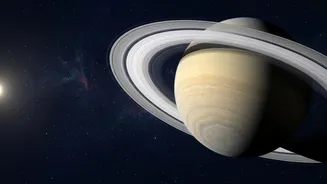
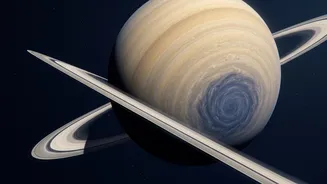
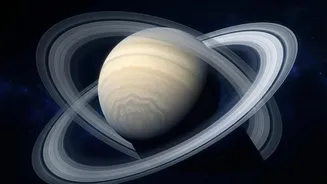
Saturn has long been known as the jewel of the solar system for its stunning rings, but its atmosphere is just as captivating. For over 40 years, scientists have been fascinated by a persistent, six-sided jet stream at its north pole, known as the hexagon.
This feature, wider than two Earths, is a massive weather system unlike anything in our solar system. For years, researchers wondered if a similar geometric storm might exist at the planet's south pole. After years of searching, new observations have finally delivered a surprise: a polygon has indeed formed, but it's not another hexagon.
Hubble Spots a Developing Decagon
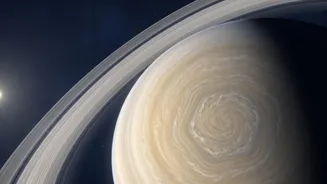
Recent analysis of images from the Hubble Space Telescope has confirmed the existence of a giant, 10-sided atmospheric wave encircling Saturn's south pole. This newly observed 'decagon' is the first large, regular-sided storm pattern ever seen in the planet's southern hemisphere. Scientists with NASA's Outer Planet Atmospheres Legacy (OPAL) program, which monitors the outer planets annually, pieced together observations to track its development. By reviewing archival data, they found faint hints of the structure emerging in 2023, with the pattern becoming much more distinct in subsequent images. This discovery provides a rare opportunity to watch a massive planetary weather system form in near real-time.
Why Now? A Question of Timing and Tech
A key reason the decagon was only just discovered is due to Saturn's long seasons and axial tilt. The planet's south pole was largely hidden from Earth-based views for years, only coming back into clear sight around 2023. Even NASA's Cassini spacecraft, which orbited Saturn from 2004 to 2017, saw no evidence of a persistent polygon at the south pole. The discovery was first hinted at in images from amateur astronomers before being confirmed with high-resolution data from Hubble. The fact that it appeared so recently has scientists intrigued. "The question is, why did it suddenly form now when we haven't seen one before?" asked Amy Simon, a NASA scientist and co-author of the study.
Not Just a Cloud Pattern
Like its northern counterpart, the southern decagon is more than just a pattern on the cloud tops. Observations at different wavelengths of light show the feature's position shifting slightly, which indicates it is a deep, vertically extended structure that reaches through multiple layers of the atmosphere. It is part of a powerful jet stream, a current of air moving at hundreds of kilometres per hour. While the northern hexagon has remained stable for decades, this new decagon appears to be evolving, giving scientists a living laboratory to study the powerful fluid dynamics that shape the atmospheres of gas giants. The different number of sides—six in the north, ten in the south—suggests that the underlying conditions in the polar jets of each hemisphere are distinct.
The Science of Celestial Polygons
While visually baffling, these geometric storms are a natural result of fluid dynamics on a massive, rotating sphere. Laboratory experiments have shown that when a contained circular fluid is spun at different speeds, polygonal shapes can spontaneously form. On Saturn, the powerful jet streams at the poles act as a boundary, allowing standing waves—known as Rossby waves—to settle into these remarkably stable geometric patterns. The discovery of a second polygon on Saturn implies that the hexagon is not a complete anomaly. Instead, it suggests that forming such shapes is a fundamental behaviour of Saturn's atmosphere under the right conditions.