


Mawsmai Cave, Meghalaya: The Luminous Labyrinth
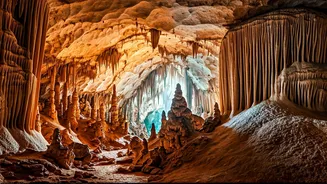
For those new to the world of caving, Meghalaya’s Mawsmai Cave is the perfect introduction. Located just a short distance from Cherrapunji, it is one of the most accessible and well-maintained cave systems in the region. The adventure here isn’t about
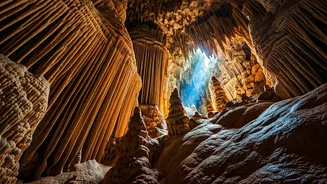
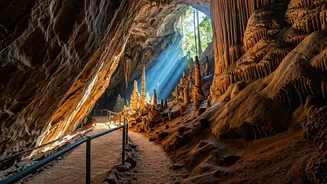
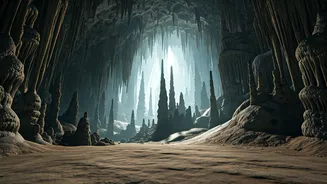
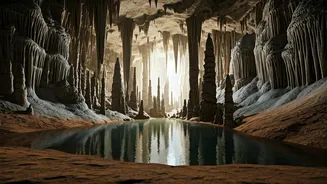
squeezing through tight crevices, but about stepping into a fully formed alien world. The cave is illuminated, revealing the intricate work of water over millennia. As you walk the designated path, you’ll find yourself surrounded by magnificent stalactites and stalagmites. Some formations resemble pillars, curtains, and even abstract sculptures. The constant drip of water echoes through the chambers, a reminder that the cave is a living, evolving entity. While the tourist-friendly section is relatively short, it packs in an incredible amount of natural wonder, making you feel like an explorer on a distant planet without needing any special gear.
Borra Caves, Andhra Pradesh: A Symphony in Stone
Deep in the Ananthagiri Hills of the Araku Valley lie the Borra Caves, considered among the largest and deepest in India. Discovered in 1807, these karstic limestone structures are a spectacle of light, colour, and form. The adventure begins as you descend into the earth, where the air grows cool and damp. The caves are famous for their speleothems—dramatic formations of stalactites and stalagmites. A key highlight is the Gosthani River, which flows through the caves and is credited with their creation. The Andhra Pradesh Tourism Development Corporation has installed a brilliant lighting system that bathes the formations in hues of green, blue, and yellow, transforming the subterranean chambers into a kaleidoscopic gallery. Local folklore connects the caves to stories of Lord Shiva, and you can find a naturally formed Shivalingam deep inside, adding a spiritual dimension to the geological marvel.
Belum Caves, Andhra Pradesh: The Endless Passage
If Borra Caves are about depth, Belum Caves are about distance. Stretching over three kilometres, this is the second-largest cave system in the Indian subcontinent and an adventurer’s dream. Exploring Belum is a true journey into the unknown. Unlike more vertical caves, Belum features long, horizontal passages with spacious chambers, freshwater galleries, and mysterious siphons. The air is thick with history and silence. One of the most fascinating sections is the ‘Patalaganga,’ a perennial stream that disappears into the depths of the earth. Another chamber, known for its musical properties, has formations that produce sounds when struck. The sheer scale of Belum Caves makes a visit feel like a genuine expedition. You are not just seeing a natural wonder; you are traversing a hidden underground network that holds secrets millions of years old.
Udayagiri & Khandagiri Caves, Odisha: A Journey Through Time
Not all cave adventures are about natural formations. Near Bhubaneswar, the twin hills of Udayagiri and Khandagiri host a complex of rock-cut caves that offer a different kind of exploration—one into history. Carved around the 1st century BCE, these were not natural caves but elaborate residences for Jain monks. The adventure here lies in deciphering the past. Each cave is a portal to an ancient way of life. The most famous among them, Udayagiri’s ‘Hathi Gumpha’ (Elephant Cave) and ‘Rani Gumpha’ (Queen’s Cave), are adorned with intricate carvings depicting historical events, royal processions, and daily life. Walking through these cool, stone corridors, you are tracing the footsteps of ascetics and artisans from over two thousand years ago. It’s an intellectual and spiritual quest, connecting you to a foundational period of Indian history written directly into the rock.