




The Martian Air Problem
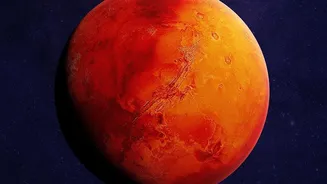
Mars presents a significant challenge for human survival. Its atmosphere is incredibly thin, about 100 times less dense than Earth's, and is composed of roughly 96% carbon dioxide. This is completely unbreathable for humans, who rely on an atmosphere rich
in oxygen. For decades, the question for scientists has been how to solve this fundamental problem. Transporting all the necessary oxygen from Earth for a long-term mission is logistically daunting and prohibitively expensive. To make a human presence on Mars sustainable, we would need to learn how to 'live off the land'—a concept known as In-Situ Resource Utilization (ISRU). The primary target for ISRU on Mars has always been its abundant carbon dioxide.
Meet MOXIE: An Oxygen Factory on Wheels
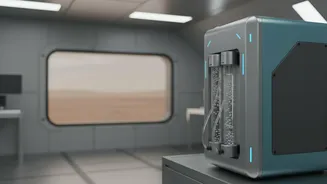
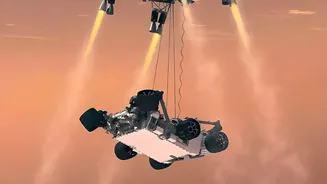
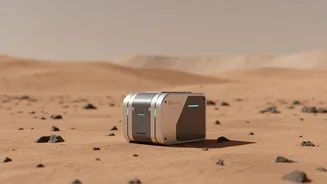
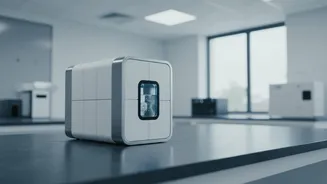
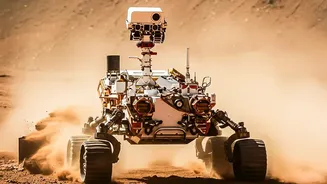
Enter the Mars Oxygen In-Situ Resource Utilization Experiment, or MOXIE. This remarkable instrument, about the size of a car battery or a small microwave oven, was sent to Mars aboard NASA's Perseverance rover. Developed in a collaboration led by the Massachusetts Institute of Technology (MIT), MOXIE's mission was straightforward but incredibly ambitious: to prove that it's possible to convert Martian carbon dioxide into pure oxygen. It's essentially a prototype for a much larger system that could one day support astronauts on the Red Planet. MOXIE is the very first device to successfully extract a natural resource from another planet for human use, marking a major milestone in space exploration.
The Science of Making Air
So, how does this mechanical tree work? MOXIE employs a process called solid oxide electrolysis. First, it acts like a vacuum, pulling in Martian air through a HEPA filter to remove dust. The air is then compressed and heated to an extreme temperature of about 800 degrees Celsius. At this high temperature, the device sends the gas through a specialized stack of materials that electrochemically splits the carbon dioxide (CO2) molecules. The process separates the CO2 into oxygen ions (O) and carbon monoxide (CO). The oxygen ions combine to form breathable, molecular oxygen (O2). This O2 is then measured for purity before being vented, while the carbon monoxide is harmlessly released back into the Martian atmosphere.
A Proven Success Story
MOXIE's mission, which concluded in 2023, was a resounding success. The instrument ran a total of 16 times under various Martian conditions, including different times of day, night, and seasons, to test its robustness against atmospheric changes. It not only met but exceeded its goals. At its peak efficiency, MOXIE produced 12 grams of oxygen per hour, which was double what NASA originally hoped for, at a purity of 98% or better. Over its entire mission, MOXIE generated a total of 122 grams of oxygen. While that's only enough to keep a small dog breathing for about 10 hours, it definitively proved that the technology works in the harsh Martian environment.
More Than Just for Breathing
While providing breathable air is a critical function, it’s not even the primary reason for generating oxygen on Mars. The biggest consumer of oxygen for a human mission will be the rocket needed to launch astronauts off the Martian surface for their journey home. A rocket requires an oxidizer to burn its fuel, and oxygen serves that purpose perfectly. It's estimated that getting a crew of four off Mars would require about 25 metric tons of liquid oxygen. Transporting that much oxygen from Earth would be incredibly difficult and expensive. By manufacturing it on Mars, future missions become dramatically more feasible and affordable.
Scaling Up for Future Astronauts
MOXIE was a trailblazing technology demonstration, but a system for a human mission would need to be much larger and more powerful. Scientists envision a future system, essentially a scaled-up version of MOXIE, that could be sent to Mars ahead of astronauts. This full-scale plant would need to be about 100 times larger than the test unit and would work continuously, producing oxygen at the rate of several hundred trees. It would generate and store tons of liquid oxygen, waiting for the first human explorers to arrive. MOXIE has provided the crucial data and confidence needed to design such a system, turning a science fiction concept into a tangible engineering goal for the future of human spaceflight.