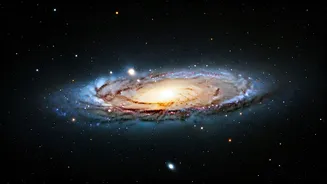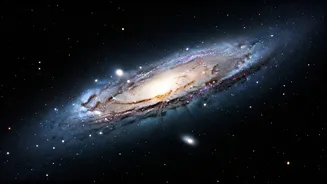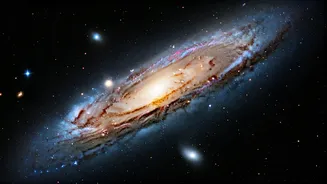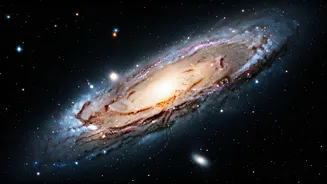




So, What Is the Cigar Galaxy?
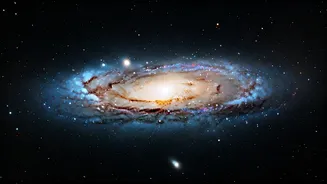
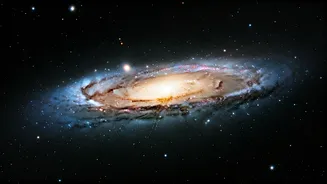
Messier 82, or M82 for short, gets its popular nickname from its elongated shape as seen from Earth. Located about 12 million light-years away in the constellation Ursa Major, it’s a relatively close neighbour in cosmic terms. But M82 isn't just any galaxy;
it's what astronomers call a 'starburst' galaxy. This means it's undergoing a period of intense and rapid star formation. Its proximity and unique characteristics make it the go-to example for scientists studying this chaotic phase of galactic life.
A Furious Factory for New Stars
To put its activity into perspective, M82 is churning out new stars about ten times faster than our own Milky Way galaxy does. This celestial baby boom isn't happening by chance. Astronomers believe this frantic activity was triggered by a gravitational run-in with its much larger neighbour, the galaxy M81. This cosmic jostling, which started hundreds of millions of years ago, funnelled enormous amounts of gas into M82's core, providing the raw fuel for millions of new stars to ignite. This star-forming frenzy is, however, a temporary event, expected to last for a few hundred million years before it burns itself out.
The Image That Sparked the Buzz
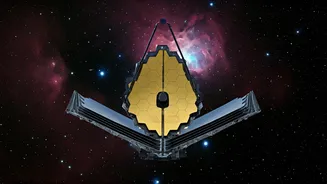
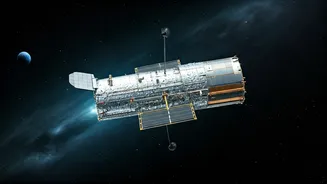
The recent surge in interest is thanks to breathtaking new images from NASA's James Webb Space Telescope (JWST). While the Hubble Space Telescope has studied M82 before, the galaxy's core is shrouded in thick clouds of cosmic dust, hiding much of the action from view. The JWST, which observes in infrared light, can pierce through this dusty veil. A recent 65-hour observation campaign allowed astronomers to resolve approximately 16.5 million individual stars and get the clearest view ever of the galaxy's violent, beautiful core.
Understanding the 'Galactic Superwind'
The most dramatic feature seen in these new images is a massive, fiery-looking plume of material being blasted out from the galaxy's center. This isn't a single explosion, but a powerful outflow known as a 'galactic superwind'. It’s created by the combined energy of the stellar winds from countless young, massive stars and the shockwaves from frequent supernova explosions. This superwind blows gas and heavy elements out of the galaxy's disk and into intergalactic space. In the composite images from Webb and Hubble, this outflow is visible as intricate tendrils of red, orange, and yellow gas and dust.
Why This Cosmic Cigar Matters
For astronomers, M82 is a perfect natural laboratory. It provides a rare, close-up look at a crucial phase in galactic evolution that was more common in the early universe. By studying the starburst and the superwind, scientists can better understand how galaxies grow, how they create and distribute heavy elements, and how these violent bursts of star formation eventually regulate themselves. The newly resolved stars act like a fossil record, allowing researchers to piece together the galaxy's turbulent history. Ironically, the very process creating all these new stars is also driving away the raw material needed for future star birth, meaning the galaxy is limiting its own growth.