


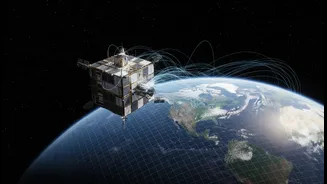



The Hidden Vulnerabilities of GPS
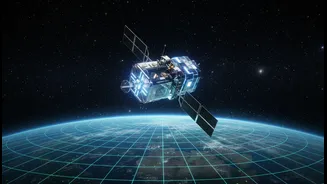
The US-owned GPS is a remarkable utility, but its reliability isn't absolute. Its signals, travelling thousands of kilometres from satellites in Medium Earth Orbit, are weak by the time they reach our devices. This makes them susceptible to a range of issues.
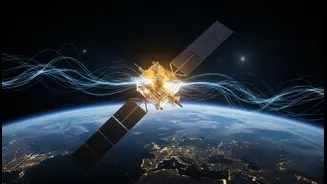
In dense urban areas with tall buildings, known as 'urban canyons', signals can be blocked or reflected, causing accuracy errors. Solar flares and atmospheric disturbances can also distort the signals. More concerning are intentional threats like jamming and spoofing. Jammers can broadcast powerful radio noise to overwhelm the faint GPS signals, while spoofing attacks involve sending false signals to trick a receiver into calculating an incorrect position or time. These vulnerabilities pose significant risks to critical infrastructure, including aviation, power grids, financial networks, and defence systems, which all depend on precise positioning and timing.
India’s Answer: The Rise of NavIC
To address these challenges and achieve self-reliance in satellite navigation, the Indian Space Research Organisation (ISRO) developed its own autonomous regional system: Navigation with Indian Constellation, or NavIC. Conceived as a sovereign system, NavIC ensures that India's critical and strategic sectors do not have to depend on foreign-controlled networks, which could be denied or degraded during geopolitical conflicts. The system consists of a constellation of satellites designed specifically to provide accurate and reliable positioning services over India and a region extending about 1,500 kilometres beyond its borders. This makes India one of a select group of nations with its own operational satellite navigation system.
How NavIC Provides a Stronger Signal
NavIC achieves higher reliability for the Indian region through its unique design. Unlike GPS satellites which are constantly moving across the sky, NavIC's satellites are placed in geostationary and geosynchronous orbits. This means they appear stationary or move in a figure-eight pattern from the ground, ensuring they are always high in the sky over India. This vertical positioning provides a much stronger and more consistent signal, especially in cities and rugged terrain where GPS signals can be obstructed. Furthermore, NavIC uses a dual-frequency system (L and S bands), which helps to correct for atmospheric distortions and improves accuracy compared to the single-frequency civilian GPS signal. For users, this translates to positioning accuracy of better than 20 metres.
Beyond Maps: Powering the Nation
The applications of a robust, sovereign navigation system go far beyond consumer maps. NavIC is crucial for national security, guiding military operations and securing communications. In disaster management, it provides reliable positioning for search and rescue teams, especially when terrestrial communication fails. The system is being integrated into various sectors of the economy. It supports real-time tracking of public transport and commercial vehicles, enhances safety for fishermen at sea, and enables precision agriculture to improve crop yields. Crucially, NavIC also provides precise timing signals, which are essential for the stability of power grids, banking transactions, and telecommunication networks.
The Future is a Multi-System World
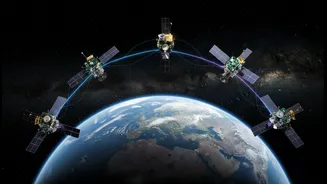
The development of NavIC is part of a global trend towards a more diverse and resilient navigation landscape. Nations like Russia (GLONASS), China (BeiDou), and the European Union (Galileo) also operate their own Global Navigation Satellite Systems (GNSS). Modern receivers in smartphones and other devices are increasingly designed to use signals from multiple constellations simultaneously. This multi-GNSS approach provides significant advantages: more visible satellites lead to faster and more accurate position fixes. It also creates redundancy, so if one system is unavailable or compromised, others can fill the gap. The future of navigation isn't about replacing GPS, but augmenting it with regional systems like NavIC to create a stronger, more reliable, and secure global network.