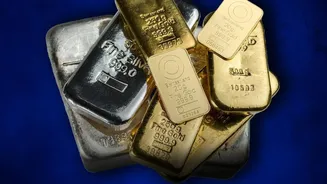







For investors in precious metals, gold and silver are timeless choices. But how do you compare them? The gold-silver ratio is a key metric that offers a quick snapshot of their relative value, helping you understand the market in a new way.
What Exactly Is the Gold-Silver Ratio?
The gold-silver
ratio is a straightforward financial metric that shows how many ounces of silver it takes to buy one ounce of gold. Also known as the XAU/XAG ratio in trading circles, it essentially measures the price of gold in terms of silver. For example, if the ratio is 80:1, it means that 80 ounces of silver are equal in value to one ounce of gold. This number isn't fixed; it changes constantly with the fluctuating market prices of both metals. By stripping out the currency—whether it's dollars, euros, or rupees—the ratio isolates the performance of the two metals against each other, offering a pure comparison of their relative strength.
How to Calculate the Ratio
Calculating the gold-silver ratio is simple. You just need the current spot prices for both metals. The formula is: Price of Gold per Ounce ÷ Price of Silver per Ounce = Gold-Silver Ratio. It doesn't matter which currency or weight unit you use, as long as it's the same for both metals—the result will be the same whether you use grams or troy ounces. For instance, if gold is trading at $4,000 per ounce and silver is at $50 per ounce, you divide 4000 by 50. The resulting ratio is 80.
A Look Back at Historical Trends
The relationship between gold and silver prices has a long and varied history. In ancient times, when both metals were used as currency, ratios were often fixed by governments and could be as low as 10:1. The United States even set an official ratio of 15:1 with its Coinage Act of 1792. In the modern era of freely floating prices, the ratio has been much more volatile. The average over the past half-century hovers around 60:1, but it has seen wild swings. It has climbed above 120:1 during times of extreme economic stress, like the COVID-19 pandemic in March 2020, and dropped to as low as 17:1 during the speculative silver peak of 1980.
Interpreting a High Ratio
A 'high' gold-silver ratio—often considered to be above 80:1—indicates that gold is significantly more expensive than silver on a relative basis. This can happen during periods of economic uncertainty when investors flock to gold as a safe-haven asset, pushing its price up faster than silver's. For some investors, a high ratio signals that silver might be undervalued compared to gold. Based on the historical tendency of the ratio to revert to its average, they might see this as an opportunity to buy silver, anticipating that it will 'catch up' to gold over time.
Understanding a Low Ratio
Conversely, a 'low' ratio—often seen as anything below 50:1—suggests that silver is relatively expensive compared to gold. This might occur during periods of strong industrial growth, as silver is a key component in sectors like electronics and solar energy, or when speculative interest in silver is high. When the ratio is low, it means silver's price has been outperforming gold's. An investor looking at a low ratio might conclude that gold is the relatively cheaper asset and could be a better value at that moment.
A Valuable Tool, Not a Crystal Ball
While the gold-silver ratio is a powerful tool for gaining perspective, it's important to understand its limitations. The ratio is an indicator of relative value, not a guaranteed predictor of future price movements. A ratio that seems historically high or low can remain at that level for a long time before it corrects. Furthermore, transaction costs and dealer markups can make frequent trading between metals expensive for individual investors. Therefore, the ratio should be used as one component of a broader investment strategy, considered alongside your personal financial goals, risk tolerance, and overall market analysis.