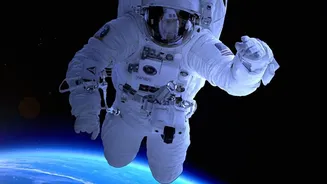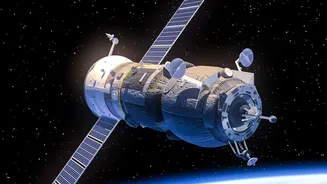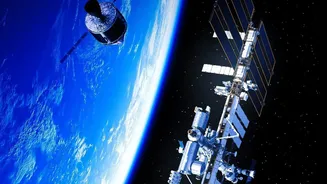




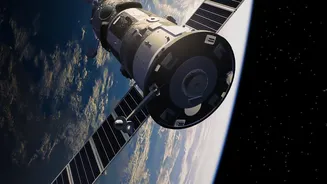
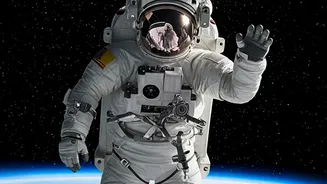
Watch any footage from the International Space Station, and you’ll see astronauts floating effortlessly. It's the classic image of 'zero gravity'. But what if we told you that at their altitude, gravity is still about 90% as strong as it is on Earth?
The 'Zero-Gravity' Misconception
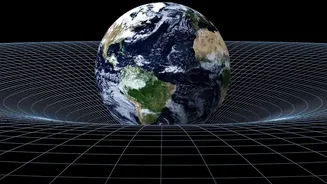
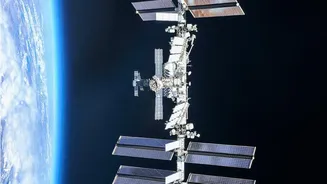
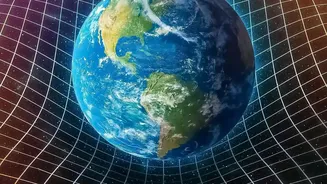
It’s one of the most common and sticky myths in science: that once you get far enough away from Earth, its gravity just disappears. We call it 'zero-g', and we picture astronauts blissfully unbound by the force that keeps our own feet on the ground. The reality, however, is far more interesting. The International Space Station (ISS) orbits at an altitude of about 250 miles (roughly 400 kilometers). While that sounds incredibly high, it’s not far enough to 'escape' Earth’s gravity in any meaningful way. Gravity's pull weakens with distance, but it doesn't just switch off. At the station's altitude, the gravitational force is still approximately 90% of what you feel right now. So if gravity is still pulling on them so strongly, why do they float?
It’s Not Floating, It’s Falling
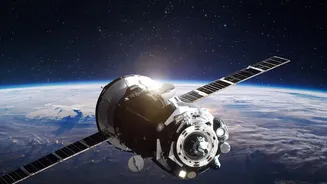
The secret to understanding weightlessness is to stop thinking about floating and start thinking about falling. Everything in orbit—the station, the astronauts, their coffee pouches, and their scientific equipment—is in a constant state of free-fall. They are all plummeting toward Earth under the influence of gravity. The reason they never crash is because they are also traveling sideways at an incredible speed: about 17,500 miles per hour (or 7.6 kilometers per second). This immense horizontal velocity means that as they fall downwards, the Earth's surface curves away beneath them at the exact same rate. They are constantly falling, but they are also constantly missing the ground. This perpetual state of falling-and-missing is what we call an orbit.
The Elevator Thought Experiment
To get a feel for this, imagine you're inside an elevator and the cables suddenly snap. For the few terrifying seconds before the emergency brakes engage, you and everything else in the elevator would be in free-fall. If you were holding a pen and let it go, it wouldn't drop to the floor; it would hover in front of you. You, the pen, and the elevator car are all falling at the same rate. You'd feel completely weightless, even though you're all under the powerful influence of Earth's gravity. The 'weightless' sensation doesn't come from a lack of gravity, but from the absence of a force pushing back up at you. On the ground, you feel weight because the floor is pushing against your feet. In a falling elevator, or in the ISS, there is no 'upward' force to feel.
Microgravity Is More Accurate
This is why scientists prefer the term 'microgravity' to 'zero gravity'. While the astronauts and the station are falling together, creating a sense of weightlessness, there are still tiny variations in the gravitational force across the large structure of the ISS. These create minuscule forces, or microgravity, that can be detected in sensitive experiments. Furthermore, there is still a very thin layer of atmosphere at that altitude, which creates a tiny amount of drag. This drag slowly causes the station to lose altitude over time, about 100 meters per day. To counteract this, the ISS must periodically fire its thrusters to boost itself back into its optimal orbit, ensuring its endless fall around our planet continues.