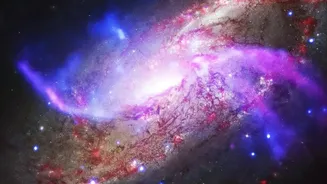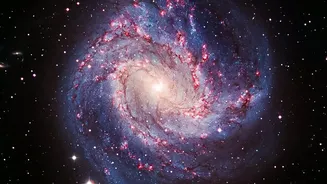




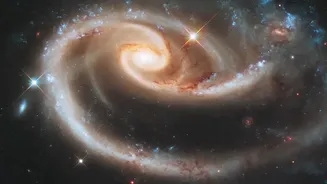
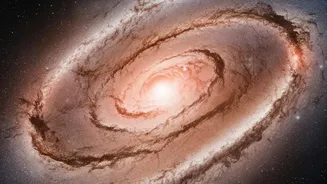
A Glimpse into the Cosmic Dawn
When you look at a galaxy billions of light-years away, you are not seeing it as it is today. You are seeing it as it was billions of years ago, when the light first began its journey across the cosmos. The James Webb Space Telescope (JWST) is designed
to capture this ancient light, peering back to a period known as the "Cosmic Dawn"—the era just a few hundred million years after the Big Bang when the first stars and galaxies ignited. Recent images have provided a stunning window into this epoch, showing galaxies forming when the universe was only about 5% of its current age. This isn't just about finding the oldest objects; it's about witnessing the universe's formative moments, a time when it transitioned from a dark, uniform sea of hydrogen and helium into the complex and structured cosmos we see today.
Rewriting the Story of Galaxy Formation
One of the biggest surprises from these new images is how mature some of these early galaxies appear. According to established cosmological models, the first galaxies should have been small, clumpy, and chaotic. Instead, astronomers are finding galaxies that seem remarkably bright, massive, and well-structured far earlier than anticipated. This has sparked a vibrant debate among scientists. Are our models of galaxy formation incomplete? Or are we misinterpreting the data? Some recent simulations suggest that these galaxies may not be as massive as they appear, but are instead experiencing intense, irregular bursts of star formation that make them glow with exceptional brightness. Whatever the answer, these observations are forcing a major rethink of how quickly galaxies could grow and assemble in the young universe.
The Fuel for the First Stars
Galaxies grow by turning vast reservoirs of cool molecular gas into stars. For a long time, astronomers suspected that early galaxies must have contained enormous supplies of this fuel to grow so quickly, but directly detecting it at such extreme distances was a major challenge. However, recent breakthroughs using powerful radio telescopes have finally allowed scientists to detect huge reserves of this star-forming gas in galaxies seen when the universe was just 700 million years old. One galaxy, known as REBELS-25, was found to have a massive reservoir of cool gas, providing direct evidence that the ingredients for rapid star formation were indeed present in the early cosmos. These findings are a critical piece of the puzzle, explaining how galaxies in the Cosmic Dawn were able to build up their stellar populations so efficiently.
Challenging Our Cosmic Models
These new discoveries don't necessarily mean our entire understanding of cosmology is broken, but they do highlight gaps in our knowledge. The unexpected brightness and maturity of early galaxies have prompted some to question the standard model of cosmology itself. The data from Webb and other observatories act as a crucial stress test for our theories. Each image of a surprisingly massive galaxy or an unexpectedly bright starburst provides new data points that theorists must account for. This interplay between observation and theory is how science moves forward. The images are not just confirming what we know; they are pushing the boundaries and forcing us to ask deeper questions about the roles of dark matter, black holes, and the fundamental processes that governed the universe's evolution.