



A Sweet Discovery in a Cosmic Cloud
In a breakthrough for astrochemistry, scientists have detected a sugar molecule called erythrulose floating in a vast cloud of gas and dust near the Milky Way's center. This marks the first confirmed detection of a true sugar in interstellar space, the void
between stars. The molecule was located in a molecular cloud known as G+0.693-0.027, a region approximately 26,700 light-years from Earth that is already famous among astronomers for its rich and complex chemistry. While other organic compounds have been found in meteorites and asteroid samples, finding a sugar freely floating in a star-forming nursery provides powerful new evidence that the chemical precursors to life can form naturally in space, long before planets come into existence.
The Galaxy's Chemical Kitchen
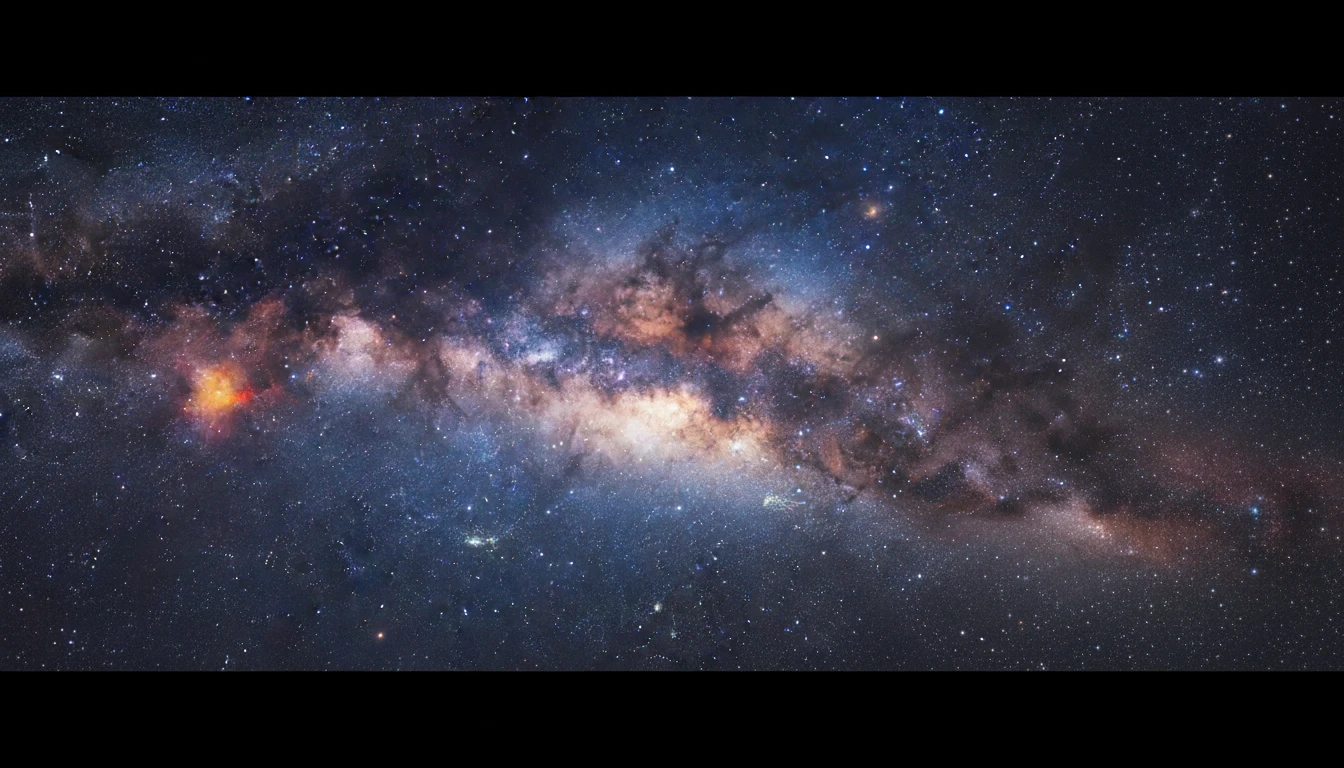
The galactic core, also known as the Central Molecular Zone (CMZ), is a turbulent and hostile environment. It's packed with dense gas clouds, buffeted by intense radiation, and influenced by the immense gravity of Sagittarius A*, our galaxy's supermassive black hole. For a long time, it was unclear if complex molecules could even survive, let alone form, in such extreme conditions. However, recent surveys using powerful radio telescopes have painted a new picture. These observations, particularly from the Atacama Large Millimeter/submillimeter Array (ALMA) in Chile, have revealed that this region is a surprisingly efficient chemical kitchen. Dozens of different molecules, from simple ones like silicon monoxide to more complex organics like methanol and ethanol, have been cataloged, showing that the core is a hotbed of chemical activity.
How They Found the Cosmic Sugar
Detecting a specific molecule across thousands of light-years is a monumental task. Scientists used a technique called radio astronomy, pointing powerful telescopes in Spain toward the target cloud. Every molecule vibrates and rotates at specific frequencies, emitting a faint radio wave that acts like a unique fingerprint. By capturing these signals and comparing them to the exact wavelength patterns of erythrulose measured in a laboratory, the team could confirm its presence. The discovery was led by researchers at Spain's Centre for Astrobiology (CAB) using data from the Yebes Observatory and the Institute for Radio Astronomy in the Millimeter Range (IRAM). This method allows astronomers to piece together the chemical inventory of distant and visually obscured regions of space.
Challenging a Long-Held Theory
The discovery of erythrulose, a four-carbon sugar, was particularly surprising because scientists couldn't find significant traces of simpler, three-carbon sugars in the same cloud. This finding challenges the prevailing theory of astrochemistry, which suggests that complex molecules build up sequentially, one carbon atom at a time. Instead, researchers now theorize that erythrulose might have formed by combining two smaller, two-carbon molecules that were also found in the cloud. This suggests that there may be multiple, more efficient pathways for creating complex organic molecules in interstellar space than previously thought. The presence of such a relatively complex sugar indicates that the chemical foundations for life could be more robust and widespread across the galaxy.
The Building Blocks of Life
So, why is finding sugar in deep space so important? Sugars are essential for life as we know it. They are a source of energy and, critically, form the structural backbone of RNA and help create DNA. The detection of erythrulose and other complex organic molecules, like the branched-chain iso-propyl cyanide found in another galactic core cloud called Sagittarius B2, hints that the building blocks of amino acids and other life-critical compounds could be common in star-forming regions. It supports the idea that Earth may have been seeded with these essential ingredients by comets and asteroids that formed in a chemically rich environment, kickstarting the journey toward life on our planet billions of years ago.