



Our Sentinels on the Sky
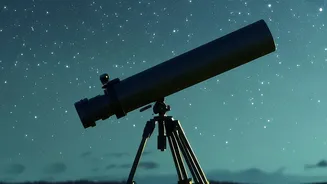
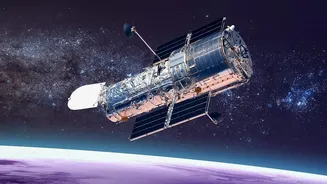
When we think of telescopes, we often picture astronomers gazing at distant galaxies. While they certainly do that, many of today's most advanced observatories are also tasked with a more immediate mission: planetary defense and fundamental physics research.
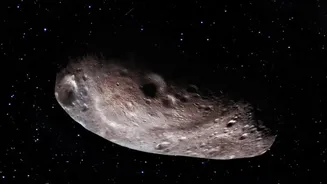
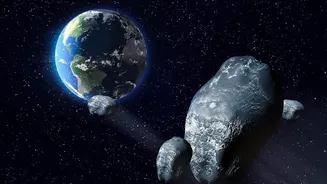
They act as our planet's early-warning system, scanning the skies not just for what is beautiful, but for what might be dangerous or what could rewrite our understanding of the universe. This dual mission focuses on two very different types of celestial traffic: tangible, rocky asteroids that could pose an impact threat, and intangible, ultra-high-energy particles known as cosmic rays that carry secrets about the most violent events in the cosmos.
The Hunt for Hazardous Asteroids
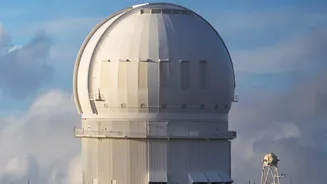
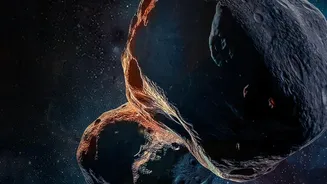
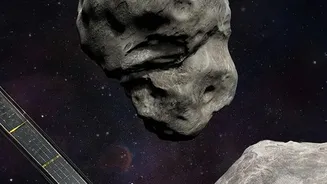
For the first time in history, humanity has the ability to detect and track asteroids before they pose a threat. This is largely thanks to a network of dedicated survey telescopes that methodically scan the sky every clear night. Projects like the Catalina Sky Survey and Pan-STARRS take multiple images of the same patch of sky and use sophisticated software to spot any faint dot that moves against the background of stationary stars. If a moving object is detected, its position is sent to the Minor Planet Center, a global clearinghouse for asteroid data. Other observatories then perform follow-up observations to refine the object's orbit. By piecing together these data points, scientists can predict an asteroid's path for decades to come, determining if it will safely pass by or if it is a 'Potentially Hazardous Asteroid' (PHA) requiring closer monitoring.
Next-Generation Asteroid Hunters
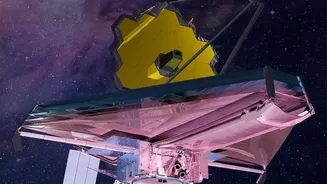
The field of planetary defense is set to be revolutionized by the Vera C. Rubin Observatory in Chile. With its enormous mirror and the world's largest digital camera, Rubin will survey the entire southern sky every few nights, discovering millions of new asteroids. Its sensitivity allows it to spot smaller and more distant objects than ever before. Even in its preliminary testing phases, Rubin has already identified tens of thousands of new asteroids. Complementing ground-based efforts is NASA’s upcoming NEO Surveyor, a space-based infrared telescope. By detecting the heat signature of asteroids, NEO Surveyor will be particularly effective at finding objects that are difficult to spot in visible light, providing a more complete census of any potential threats.
Detecting Invisible Cosmic Bullets
At the other end of the spectrum are high-energy cosmic rays. These are not solid objects but subatomic particles—mostly protons and atomic nuclei—accelerated to nearly the speed of light by cataclysmic events like supernovae or supermassive black holes. These particles are so energetic they are like invisible bullets, but they don't reach the ground directly. Instead, when a cosmic ray strikes the upper atmosphere, it shatters air molecules and creates a cascade of billions of secondary particles called an 'extensive air shower'. It's this shower, which can spread over many square kilometres, that telescopes are designed to detect.
Telescopes That See the Air Glow
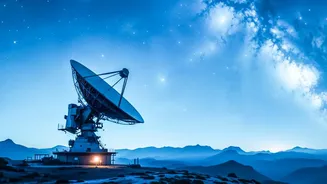
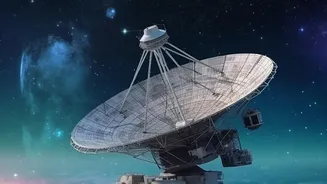
Telescopes cannot see cosmic rays directly, so they look for the faint, fleeting light these particle showers produce in the atmosphere. Two primary techniques are used. The first detects the faint ultraviolet 'fluorescence' light emitted by nitrogen molecules as the shower passes through the air. The second method uses Imaging Atmospheric Cherenkov Telescopes (IACTs). These instruments detect the brief flash of blue 'Cherenkov radiation' that is produced when shower particles travel faster than the speed of light in air. Observatories like the Pierre Auger Observatory in Argentina and the upcoming Cherenkov Telescope Array (CTA) use arrays of these specialised telescopes to capture this light. By analyzing the timing and brightness of the light, scientists can reconstruct the energy and direction of the original cosmic ray, tracing it back toward its mysterious source.