






A Major Milestone at 88 Percent
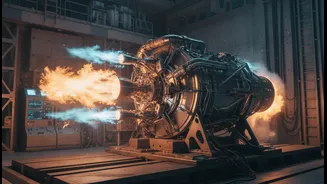
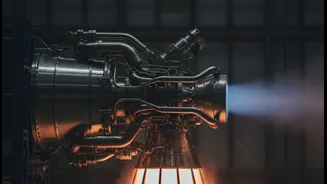
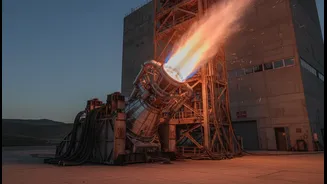
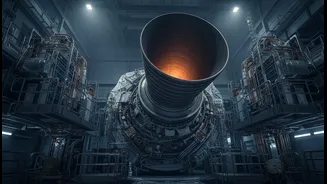
In a significant achievement, the Indian Space Research Organisation (ISRO) successfully conducted a hot test of its SE-2000 semicryogenic engine's power head, reaching 175 tonnes of thrust. This represents 88% of the engine's final target thrust of 200 tonnes.
The test, carried out at the ISRO Propulsion Complex in Mahendragiri, was the eighth and most powerful in a series, following previous successful tests at lower thrust levels. Critically, the test validated the performance of the engine's core components—the turbopumps, pre-burner, and control systems—which form the heart of the engine. ISRO confirmed that all parameters performed as expected, giving the agency confidence to proceed with future tests aimed at reaching the full 100% thrust level.
What is a Semicryogenic Engine?
Think of a rocket engine as a controlled explosion. The more powerful the explosion, the more thrust you get. ISRO's current heavy-lifter, the LVM3, uses a combination of solid boosters and liquid-fuelled stages. The new SE-2000 is a semicryogenic engine, which represents a major technological leap. Instead of using liquid hydrogen, which is difficult and expensive to handle as it must be kept at extremely cold temperatures, a semicryogenic engine uses a highly refined form of kerosene (dubbed 'Isrosene') as fuel and liquid oxygen (LOX) as the oxidiser. Because only the LOX is cryogenic (super-cooled), it's called 'semi-cryogenic'. This fuel is denser, more stable, and cheaper than liquid hydrogen, allowing for more powerful and efficient rockets.
The Goal: A More Powerful LVM-3
The primary goal for the SE-2000 engine is to power a new core stage, the SC120, for India's workhorse LVM-3 rocket. This new stage will replace the current L110 stage, which is powered by two Vikas engines. By swapping in the more powerful semicryogenic engine, ISRO expects to significantly boost the LVM-3's payload capacity. This upgrade will allow the rocket to lift heavier satellites into orbit, potentially increasing its capacity to Geosynchronous Transfer Orbit (GTO) from four tonnes to five tonnes. This enhancement is crucial for launching heavier communication satellites, supporting ambitious deep space missions, and strengthening India's position in the global commercial launch market.
What a 'Power Head' Test Can't Prove
While the recent test was a massive success, it was a test of the Power Head Test Article (PHTA). This means it included almost all the complex machinery except for the main thrust chamber and nozzle—the parts that actually shape and direct the fiery exhaust. Think of it as testing a car's engine, fuel pump, and transmission perfectly on a test bench, but without attaching the wheels and putting it on the road. The test proves the core machinery can handle the immense pressures and temperatures, but it doesn't demonstrate how the complete, integrated system will perform under the strain of a full-duration burn. It's a vital step, but it is not the final exam.
The Long Road to Flight Qualification
Rocket engineering is a game of inches and increments. The next hurdles are even bigger. First, ISRO must test the engine at its full 100% thrust level. Following that, engineers need to conduct a full-duration hot fire test, where the complete engine assembly is fired for the same amount of time it would run during an actual launch—hundreds of seconds, not just a few. This is essential to check for endurance and ensure no hidden issues arise during a long burn. Finally, the engine must be integrated into the SC120 stage, and the entire stage must be tested. Only after this rigorous, multi-year process of qualification can the engine be declared flight-ready. Each step is designed to methodically eliminate risk before the engine is trusted to power a multi-crore rocket into space.