



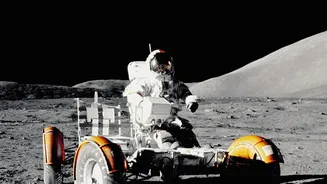
The Challenge of Living Off The Land
For humanity to establish a sustainable foothold on the Moon, as planned under the Artemis program, astronauts can't rely solely on expensive resupply missions from Earth. The cost of launching every gallon of water, every tool, and every breath of air
is astronomically high. This is where In-Situ Resource Utilization, or ISRU, comes in. ISRU is the principle of using local materials to survive and operate. On the Moon, the most plentiful resource is regolith—the layer of dust and crushed rock covering the surface. It may look barren, but scientifically, it's a treasure chest. Lunar regolith is about 45% oxygen by mass, but that oxygen is chemically locked away inside silicate minerals. The challenge, which NASA is actively working to solve, is how to break those chemical bonds and release the oxygen.
From Dust to Oxygen: How It Works
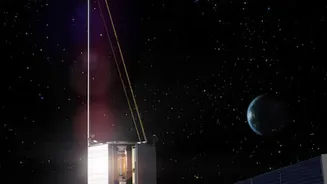
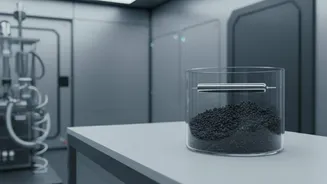
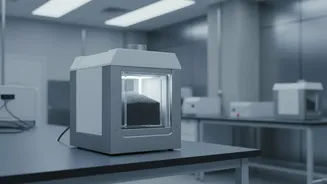
NASA is pioneering several methods to bake air out of rock, with a leading process known as carbothermal reduction. The Carbothermal Reduction Demonstration (CaRD) project is a key initiative in this field. In simple terms, the process involves heating the lunar regolith to extremely high temperatures—over 3,000 degrees Fahrenheit (around 1,700°C)—until it melts. This is often done in a specialized reactor using a powerful laser or a solar concentrator to simulate and harness the power of sunlight. Once the regolith is molten, an electric current is passed through it in a process called electrolysis. This chemical reaction breaks the metal-oxygen bonds, releasing oxygen as a gas. Recent tests using simulated moon dust in vacuum chambers have successfully produced carbon monoxide, which downstream systems can then convert into pure, breathable oxygen.
More Than Just Breathable Air
The oxygen produced from these experiments has applications far beyond just life support. A significant portion could be used as liquid oxygen (LOX), a critical component of rocket propellant. The ability to refuel spacecraft on the Moon would dramatically lower the cost and complexity of missions departing from the lunar surface, whether they are returning to Earth or venturing farther out to Mars. This effectively turns the Moon into a planetary gas station, a key piece of infrastructure for a future space economy. Furthermore, the extraction process doesn't just yield oxygen; it also leaves behind a variety of metal alloys as a byproduct. These metals could potentially be used in 3D printing and construction, allowing astronauts to build habitats, tools, and other necessary infrastructure directly on site.
The Road Ahead for Lunar Life
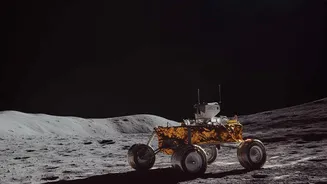
While experiments at NASA's Johnson Space Center and Kennedy Space Center have proven the technology can work on Earth, the next step is proving it on the Moon. Engineers are designing reactors that are durable enough to withstand the harsh lunar environment—including extreme temperature swings and abrasive dust—while operating efficiently. Teams are working on integrating the technology into robotic missions that could autonomously excavate regolith and feed it into the oxygen-producing reactors. The success of projects like CaRD, funded by NASA's Game Changing Development program, is a critical milestone, moving the technology closer to being ready for deployment on an actual Artemis mission. These efforts are not just isolated experiments; they are foundational steps toward building a permanent, self-sustaining human presence beyond Earth.