




First, Find the Summer Triangle
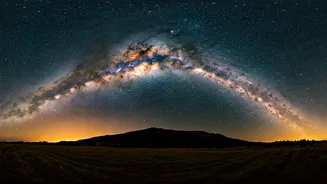
Your cosmic treasure map begins with the Summer Triangle. This isn't a constellation, but an asterism—a prominent pattern of stars. It’s huge and unmistakable. As darkness falls during summer and autumn evenings in India, look high overhead for three
brilliant stars that form a giant triangle. The brightest of these is Vega, a piercing blue-white gem. The second is Altair, which shines lower in the south, and the third is Deneb, which completes the triangle to the east. This trio of stars, from three different constellations (Lyra, Aquila, and Cygnus), serves as your primary signpost. Finding it is the first and easiest step on your journey to the Ring Nebula.
Zoom In on Lyra and Vega
The Ring Nebula lives within the small constellation of Lyra, the Harp. The good news is, you've already found its most important star: Vega. It’s one of the brightest stars in the entire night sky, so it's hard to miss. Once you’ve located Vega, you’ve found the constellation Lyra. Look just to the side of Vega for a small, faint parallelogram of four stars. This little boxy shape forms the body of the harp. The Ring Nebula is located inside this parallelogram, which makes it relatively easy to narrow down your search area. You're no longer scanning the whole sky, but a tiny patch within this ancient celestial instrument.
The Quarry: What is the Ring Nebula?
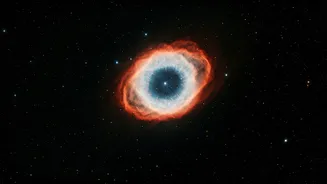
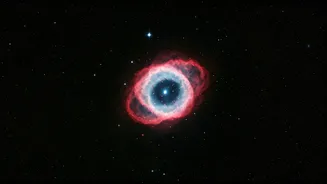
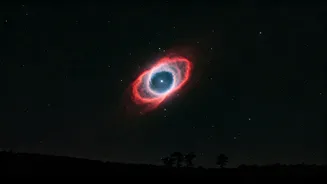
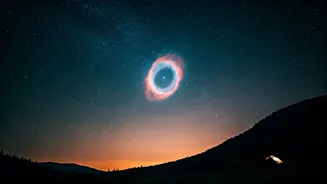
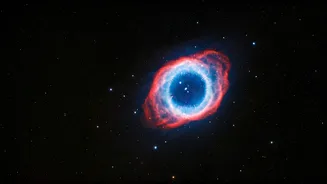
So, what are you looking for? The Ring Nebula, also known by its less romantic catalogue name Messier 57 (M57), is a planetary nebula. But that name is misleading—it has nothing to do with planets. It's the glowing, expanding shell of gas that was shed by a star like our sun at the end of its life. About 2,600 light-years away, the star at its centre has puffed off its outer layers, which are now illuminated by the intense ultraviolet radiation from the hot, tiny core left behind. You’re essentially looking at the beautiful, ghostly remains of a star’s death, a cosmic smoke ring that has been expanding for thousands of years. It’s a preview of what our own sun might do in about five billion years.
Your Step-by-Step Viewing Guide
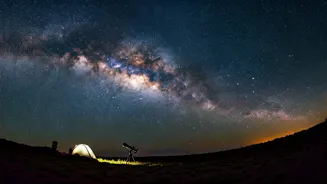
Ready to find it? You'll need a dark sky, away from city lights if possible. Let your eyes adjust for about 20 minutes.
1. Locate Vega: Find the brightest star in the Summer Triangle.
2. Find the Parallelogram: Identify the four fainter stars of Lyra’s harp near Vega. The two stars at the bottom of the parallelogram (farthest from Vega) are your targets. Their names are Sheliak and Sulafat.
3. Scan Between the Stars: The Ring Nebula is located about 40% of the way along an imaginary line drawn from Sulafat to Sheliak. Grab a pair of binoculars. Slowly scan this area. Don't look for a sharp ring—at this magnification, you're searching for a tiny, fuzzy, out-of-focus-looking 'star' or a faint, greyish patch.
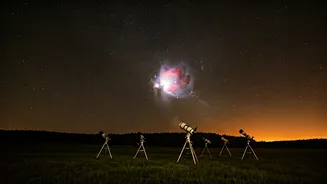
4. Use a Telescope: If you have a small telescope, centre that fuzzy patch in your eyepiece. With a magnification of 100x or more, the 'star' will resolve into a distinct, ghostly doughnut or smoke ring. The sight is subtle but unforgettable.
A New Look at an Old Favourite
While the view from a backyard telescope is a ghostly grey-green circle, modern science gives us a breathtaking new perspective. In 2023, the James Webb Space Telescope (JWST) captured the Ring Nebula in unprecedented, jaw-dropping detail. These new images reveal intricate filaments of hydrogen gas, complex structures in the inner ring, and even distant background galaxies shining right through the nebula’s translucent gas. What we see as a faint smudge is, in reality, a place of mind-boggling complexity and beauty. Looking at M57 with your own eyes connects you directly to the same object that is pushing the boundaries of astronomical research.