
An Eye on a Sun-Like Star's Fate
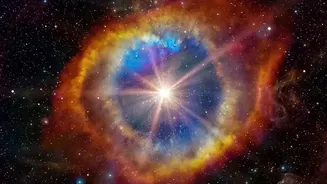
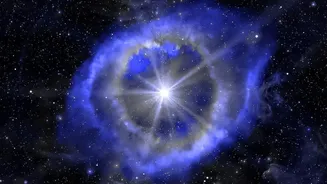
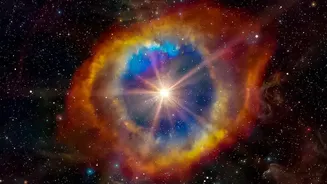
Located about 650 light-years away, the Helix Nebula is one of the closest and most famous examples of a planetary nebula. Despite the name, it has nothing to do with planets. Instead, it’s the intricate, glowing shell of gas and dust cast off by a star
similar to our own Sun as it reached the end of its life. For thousands of years, this star has been shedding its outer layers, which expand into space, while its core collapses into a super-dense, hot white dwarf. This process creates the stunning structure that, through earlier telescopes, earned it the nickname the 'Eye of God'. The Helix Nebula essentially provides a preview of what our own Sun's distant future might look like in about five billion years.
Webb's Unprecedented Infrared Vision
While observatories like Hubble have captured breathtaking images of the Helix Nebula before, the James Webb Space Telescope sees the universe in infrared light, allowing it to peer through obscuring dust and reveal different structures with incredible clarity. The latest images from Webb's Near-Infrared Camera (NIRCam) provide the sharpest view yet of the nebula’s inner regions. Webb’s view highlights the violent interaction where hot, fast winds from the central white dwarf slam into cooler gas and dust ejected by the star earlier in its life. This collision sculpts the nebula’s features and reveals a stark transition from the hottest gases near the star to the coolest ones farther out.
A Close-Up on 'Cometary Knots'
One of the most intriguing features of the Helix Nebula are thousands of tiny, tadpole-shaped structures called “cometary knots.” Though they look small, each knot is immense—their heads are at least twice the size of our solar system, and their tails can stretch for 100 billion miles. Webb’s detailed images bring these knots to the forefront. These are dense clumps of molecular gas and dust that have so far survived the intense radiation from the central star. It’s believed they form as the star's powerful winds fragment the surrounding gas clouds into smaller, denser droplets. These knots are crucial because they act as protective pockets where molecules can survive and complex chemistry can occur.
From Stellar Ashes to New Worlds
This is where the cosmic recycling story comes full circle. The material being expelled by the dying star—including the gas, dust, and the contents of these cometary knots—is rich with heavier elements like carbon, nitrogen, and oxygen, forged inside the star over billions of years. As this material spreads out, it mixes with the interstellar medium, the diffuse gas and dust between stars. Webb’s observations help show how this material is processed and distributed. These enriched clouds of debris will eventually cool, and gravity will pull them together to form the next generation of stars and planets. In essence, the death of this one star is directly seeding the birthplace of future solar systems, carrying the raw ingredients necessary for planets and, just maybe, life itself.