







What to Look For This August
August 2026 is a fantastic month for skywatching. The biggest event was the annual Perseid meteor shower, which peaked around August 12-13. While the peak has passed, the shower remains active until August 24, so you might still catch a few stray 'shooting
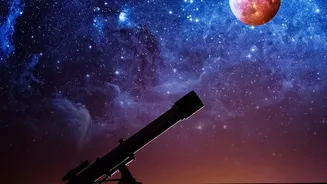
stars' in the late evening. This year's peak was special because it coincided with a New Moon, making the sky exceptionally dark for viewing. Looking ahead, keep an eye out for a deep partial lunar eclipse, also known as a 'Blood Moon', happening around August 27-28. While not a total eclipse, it will still be a beautiful sight as the Earth's shadow covers a large part of the Moon. Planets are also putting on a show. Mars and Saturn are often visible to the naked eye, while a close approach of Jupiter and Mercury happens around August 15.
Beat the Glow: The Light Pollution Problem
The main challenge for any urban stargazer is light pollution. The combined glow from streetlights, buildings, and cars creates a bright haze called 'skyglow' that washes out all but the brightest celestial objects. Effectively, our city lights are competing with the starlight. This is why you might only see a handful of stars from a city balcony, compared to the thousands visible from a remote village. Understanding this is the first step to overcoming it. Your goal is to find pockets of relative darkness and shield your eyes from direct, glaring lights. Even small reductions in ambient light can make a big difference in what you're able to see.
Find Your Urban Observatory
You don't necessarily need to drive for hours. The key is to find the darkest possible spot within your urban or suburban environment. Rooftops or high balconies can be great, as they lift you above the immediate glare of streetlights. Local parks, sports fields, or any large, open area away from dense commercial lighting are also excellent choices. The goal is to put some distance and physical barriers between you and direct light sources. Even a spot with a clear view of the sky that is shielded by a building or a line of trees on one side can improve your viewing experience. For those in India, the post-monsoon period often brings clearer skies as the rain washes dust and pollutants from the air, temporarily improving visibility even in cities.
Let Your Eyes Adapt
This is perhaps the most crucial and overlooked tip for city stargazing. Your eyes need time to adjust to the darkness. It takes about 20 to 30 minutes for your pupils to fully dilate and for your eyes to build up the light-detecting chemicals needed for proper night vision. During this time, you must avoid all bright lights, especially the screen of your phone. Even a quick glance at a bright screen can reset your night vision, forcing you to start the process all over again. If you need to use a light, a red-light torch is ideal because red light has a minimal effect on your night vision. Many stargazing apps also have a 'night mode' that turns the interface red for this exact reason.
Use Technology to Your Advantage
A smartphone can be your best friend. There is a host of excellent stargazing apps—like SkySafari, Stellarium, or Star Walk—that can help you identify what you're looking at. These apps use your phone's GPS and compass to create a real-time map of the sky. Just point your phone upwards, and the app will label the constellations, planets, and even satellites passing overhead. This is invaluable for beginners who might not know where to look for specific objects. Many of these apps also provide alerts for upcoming celestial events, like meteor shower peaks or space station flyovers, ensuring you don't miss out.
Patience and Perspective
Urban stargazing requires a different mindset. You won't see a sky blanketed with the Milky Way like you would in Ladakh or Spiti Valley. Instead, the goal is to celebrate the small victories. Seeing the craters on the Moon through a simple pair of binoculars, identifying Jupiter and its moons, or catching a single, bright meteor streak across the sky can be deeply rewarding. The planets and the Moon are excellent targets for city viewing because their brightness cuts through the light pollution effectively. Don't get discouraged if you only see a few things at first. The more you practice looking, the more you will start to notice.