



What Makes a Nebula Crimson?
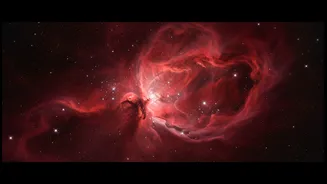
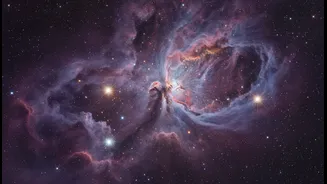
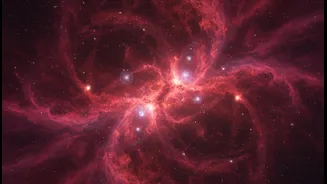
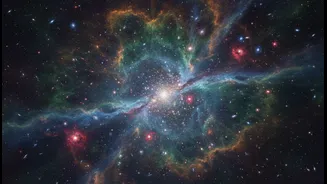
The term "Crimson Nebula" isn't an official name for a single object, but a poetic description for the spectacular red glow seen in many star-forming regions, also known as HII regions. These cosmic clouds are made mostly of hydrogen gas. Their distinctive
reddish-pink color comes from a process called ionization. Nearby, massive young stars blast the nebula with intense ultraviolet radiation. This high-energy light energizes the hydrogen atoms, causing them to emit light at specific wavelengths, with the most prominent one being a deep red known as hydrogen-alpha. This crimson light is a telltale sign that a region is an active stellar nursery, a place where new stars are being born.
Inside the Stellar Nursery
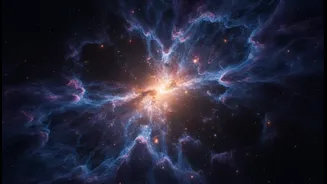
Stellar nurseries are vast, cold clouds of gas and dust that can span hundreds of light-years. While they appear serene from afar, they are dynamic environments where gravity is the master architect. Over millions of years, the gentle but persistent pull of gravity starts to draw the diffuse gas and dust into denser clumps. As these clumps grow, their gravitational pull increases, attracting more and more material in a runaway process. These collapsing cores are the seeds of future stars. Astronomers study these dense regions, sometimes called Bok globules, to understand the very first steps of star and planet formation.
The Birth of a Star
As a cloud collapses, the material at the center gets packed tighter and tighter, causing the core to heat up and become incredibly dense. This hot, dense core is known as a protostar—not yet a true star, but on its way. The protostar continues to pull in gas and dust from a surrounding disk for millions of years. Eventually, the pressure and temperature at its core reach a critical point—millions of degrees—triggering nuclear fusion. At this moment of stellar ignition, hydrogen atoms begin fusing into helium, releasing an immense amount of energy. This energy pushes outward, creating a stable balance against gravity's inward crush, and a new star begins to shine.
Sculpted by Newborn Stars
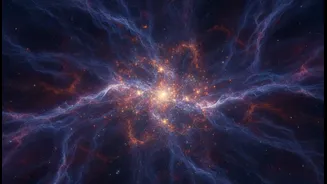
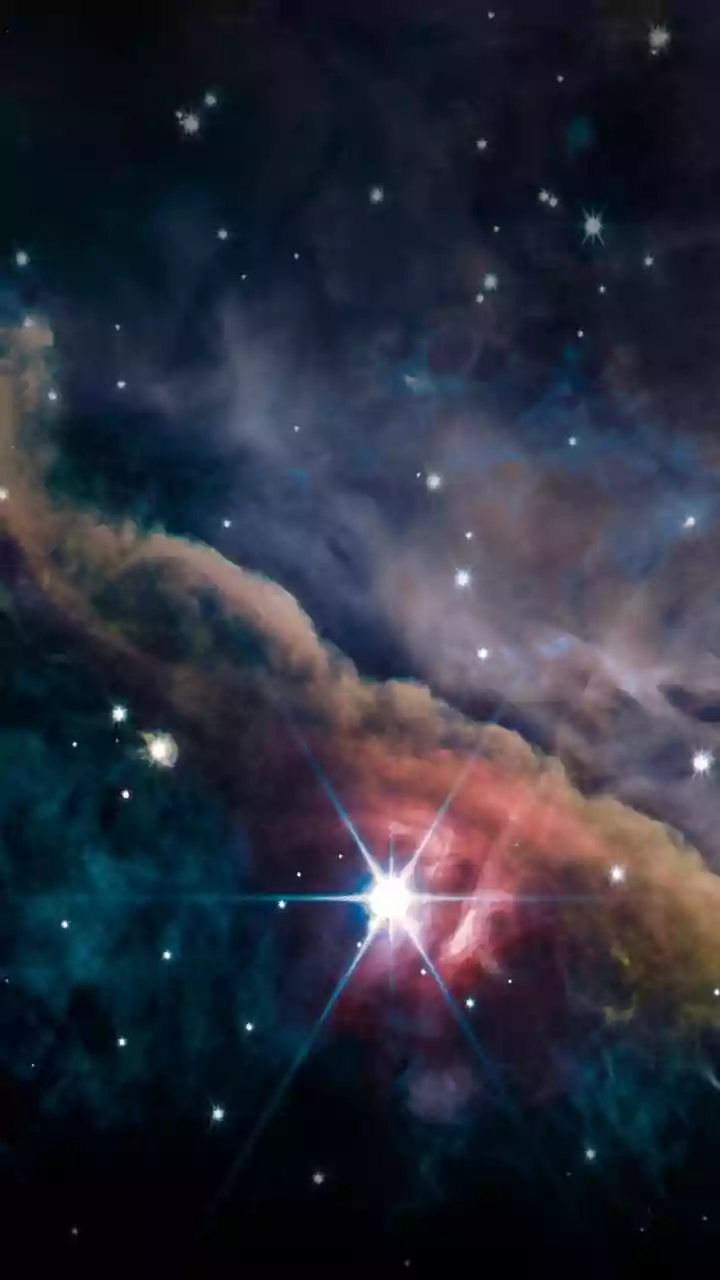
The birth of massive stars dramatically transforms their environment. Once ignited, these powerful stars unleash fierce stellar winds and floods of radiation that blast through the surrounding nebula. This energetic output carves out vast cavities, creating the stunning pillars, arches, and ridges we see in images from telescopes like Hubble and the James Webb Space Telescope. Features like the famous "Pillars of Creation" in the Eagle Nebula are sculpted by this process. The radiation from these hot, young stars not only makes the gas glow but can also compress nearby material, potentially triggering the next wave of star formation in a cosmic chain reaction.
Reading the Cosmic Story
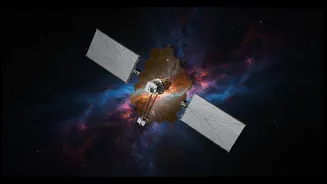
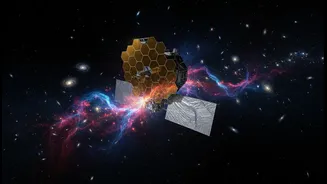
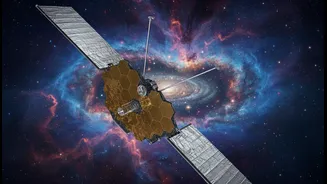
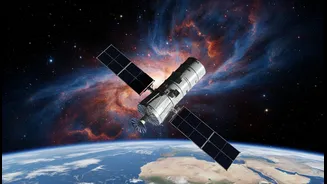
While the crimson glow of hydrogen tells us where stars are forming, much of the action is hidden deep inside dense clouds of dust. Visible light can't penetrate these dusty cocoons. To see the newborn protostars within, astronomers use infrared telescopes. Instruments on the James Webb Space Telescope, for example, can peer through the dust to capture the faint heat of these nascent stars, giving us a more complete picture of the star formation process. By studying regions like the Carina Nebula or the Orion Nebula, astronomers can observe thousands of stars at different stages of development, piecing together the timeline of how stars and their planetary systems come to be.