






The Most Perilous Minutes in Spaceflight
A rocket launch is a controlled explosion, balancing immense power and precision. The ascent through the atmosphere subjects the launch vehicle to extreme forces, from maximum aerodynamic pressure (Max-Q) to the point where it reaches supersonic speeds.
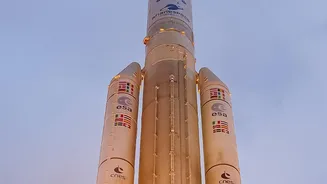
Any anomaly in the rocket's performance during this phase can become catastrophic within seconds. For the Gaganyaan mission's HLVM3 rocket, some of its powerful boosters use solid fuel, which cannot be shut down once ignited. This makes a rapid escape mechanism not just a backup plan, but an absolute necessity to ensure the crew can be pulled to safety at a moment's notice.
Introducing the Crew Escape System
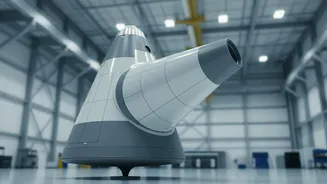
At the heart of Gaganyaan's safety protocol is the Crew Escape System (CES). This is a specially designed mechanism mounted at the very top of the rocket. It’s essentially a small, powerful rocket of its own, equipped with quick-acting solid motors that produce immense thrust. Its sole purpose is to pull the Crew Module—the capsule housing the astronauts—away from the main rocket in case of a launch failure. This 'puller' type system is designed to generate an acceleration far greater than the launch vehicle itself, yanking the crew to a safe distance in mere moments. An advanced Integrated Vehicle Health Management system constantly monitors thousands of parameters, ready to trigger the abort sequence automatically if it detects a critical failure.
Simulating Failure for Mission Success
Designing a system on paper is one thing; proving it works under real-world stress is another. This is the purpose of high-altitude abort tests. ISRO has developed a dedicated Test Vehicle (TV) to carry the Crew Module and its escape system to a specific altitude and speed to simulate a launch emergency. For the Test Vehicle Abort Mission-1 (TV-D1), conducted in October 2023, the goal was to trigger an abort at an altitude of about 17 km and a speed slightly above Mach 1 (the speed of sound). This test validates that the escape system can function correctly during the transonic phase of flight, one of the most aerodynamically unstable periods.
The Anatomy of an Abort Test
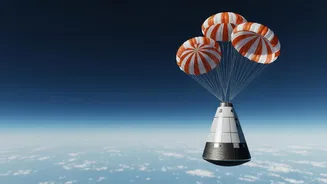
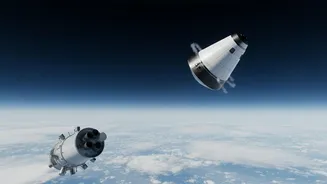
During a test like TV-D1, once the launch vehicle reaches the designated point in its ascent, the abort is intentionally triggered. The high-energy motors of the Crew Escape System fire, pulling the Crew Module away from the rocket. After reaching a safe altitude, the escape system itself jettisons. From there, a meticulously choreographed sequence of parachutes begins to deploy. First, smaller drogue parachutes stabilize the capsule and begin to slow its descent. These are followed by the massive main parachutes, which further reduce the velocity to ensure a gentle splashdown in the sea. Teams from the Indian Navy are then tasked with recovering the module, allowing ISRO scientists to analyse the extensive flight data captured during the test.
A Stepped Approach to Safety
High-altitude tests are part of a broader, methodical testing campaign. It builds upon earlier trials like the Pad Abort Test (PAT) conducted in 2018, which validated the escape system's ability to save the crew from an emergency on the launchpad itself. More recent tests, like the Integrated Air Drop Tests (IADT), have further qualified the complex parachute system. In these tests, a simulated Crew Module is dropped from a helicopter to verify the deployment sequence of the ten parachutes that ensure a soft landing. Each successful test, from the ground up to high altitudes, marks a critical step forward in proving the reliability of every component responsible for astronaut safety.