





Seeing the Universe's Invisible Light
To understand infrared's power, we first need to grasp what it is. The light human eyes can see is just a tiny sliver of the total light in the universe, known as the electromagnetic spectrum. Infrared light sits just beyond the red end of the rainbow
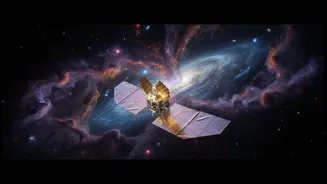
we can perceive. While we can't see it, we often feel it as heat. Every object with a temperature above absolute zero, from stars to planets and even cold dust clouds, emits infrared radiation. Space telescopes designed to detect this light, like the JWST and its predecessor, the Spitzer Space Telescope, operate as massive cosmic heat sensors, giving astronomers a completely different view of the cosmos.
Piercing Through Cosmic Curtains
One of infrared's greatest advantages is its ability to see through the dense clouds of gas and dust that block visible light. These cosmic clouds are stellar nurseries, where new stars and planets are born, but they are often opaque to traditional telescopes. Because infrared light has a longer wavelength, it can slip past these dust particles more easily, much like how you can hear the bass from a distant car before you hear the treble. This allows astronomers to peer inside these stellar nurseries and watch star and planet formation as it happens, revealing secrets that would otherwise remain hidden. It gives us a front-row seat to the creation of new worlds.
A Time Machine to the Early Universe
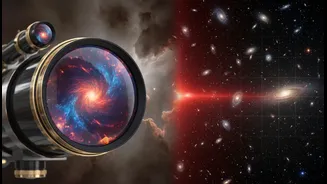
Infrared astronomy also functions as a form of time travel. The universe has been expanding since the Big Bang, and as it expands, it stretches the light traveling through it. Light from the most distant objects—the first stars and galaxies that ever formed—has been traveling for over 13 billion years. Over this immense journey, its wavelength has been stretched from visible or ultraviolet light into infrared light, a phenomenon called 'redshift'. By detecting this redshifted light, telescopes like the JWST can capture images of galaxies as they existed in the universe's infancy, providing invaluable clues about how the cosmos evolved.
From Grayscale Data to a Cosmic Masterpiece
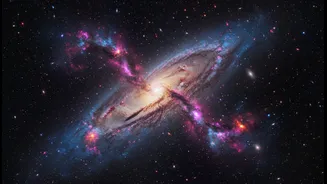
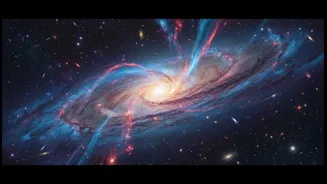
This is where the "smarter" part comes in. Space telescopes don't take color photos like a smartphone. They collect data as a series of monochrome (black-and-white) images, each one captured through a filter that isolates a specific wavelength of infrared light. The result is a set of grayscale maps showing the brightness of light at different infrared frequencies. Image processors then assign visible colors—typically red, green, and blue—to these different infrared channels. The longest infrared wavelengths are usually assigned to red, the shortest to blue, and those in between to green. When these individually colored grayscale images are layered together, they create the final, breathtaking full-color composite image. This isn't just for aesthetics; this "false color" process translates invisible data into a format that scientists can visually interpret, highlighting different materials, temperatures, and structures within the object.
A New Era of Discovery
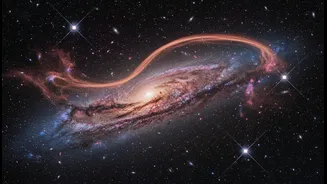
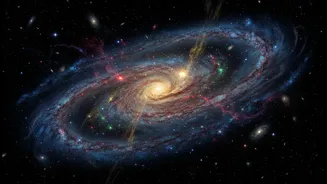
The use of infrared data isn't new—pioneering missions like the Infrared Astronomical Satellite (IRAS) in the 1980s mapped hundreds of thousands of infrared sources for the first time. But modern instruments have taken it to another level. The Spitzer Space Telescope provided unprecedented views of everything from distant galaxies to the dust disks around stars where planets form. Now, the James Webb Space Telescope, with its unparalleled sensitivity, is pushing the boundaries even further. It has revealed the atmospheric composition of exoplanets, detailed the chaotic beauty of merging galaxies, and captured the deepest and sharpest infrared images of the distant universe ever seen. These tools don't just take pictures; they collect sophisticated data that is transforming nearly every field of astronomy.