




An Ejection Seat for a Spaceship
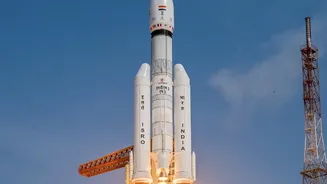
Imagine sitting atop a skyscraper-sized vehicle filled with highly volatile propellants. That's the reality for astronauts during the first few minutes of a launch. The launch and ascent are the most dangerous phases of any spaceflight. A Crew Escape
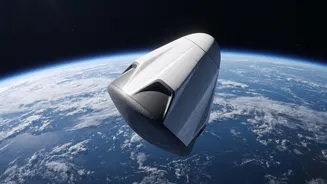
System (CES) is essentially an ejection seat, but instead of throwing out a single pilot, it yanks the entire crew capsule away from a failing rocket. Whether it's an explosion on the launchpad or a critical malfunction mid-air, the CES is designed to pull the crew module and its occupants to a safe distance, allowing them to parachute back to safety. This system is the absolute last line of defence, a life-saving measure that prioritises crew survival above all else.
The Secret to Instant Thrust
The key to outrunning an exploding rocket is immense, instantaneous power. The Gaganyaan CES achieves this using a cluster of specially designed solid rocket motors. Unlike liquid-fuel engines that require complex pumps and valves, solid motors are packed with a propellant that, once ignited, burns furiously and immediately. These are not ordinary solid motors; they use high burn-rate propellants that consume fuel far more rapidly than conventional rockets, generating tremendous acceleration. This allows the escape system to generate forces up to 10 times that of gravity, physically overpowering the launch vehicle's own thrust to pull the capsule clear within milliseconds. This brutal but survivable force is the defining feature that provides the 'instant thrust' needed to escape imminent danger.
A Symphony of Motors
The Gaganyaan's escape system isn't just one big motor. It's a coordinated set of five quick-acting solid motors that perform distinct roles in what is known as a 'tractor' configuration, pulling the module from the top. The primary High Altitude Escape Motor (HEM) and Low Altitude Escape Motor (LEM) provide the main pulling force. Simultaneously, pitch motors fire to steer the capsule, directing it up and away from the rocket's hazardous flight path. The system uses canted, or angled, nozzles to direct this thrust without needing complex and slower-moving mechanical gimbals. This entire assembly is designed to work autonomously, triggered in milliseconds by an Integrated Vehicle Health Management system that constantly monitors the rocket for any sign of trouble.
Rigorously Tested for Reliability
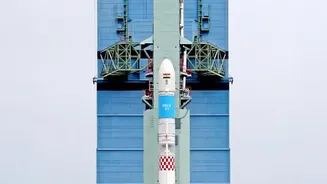
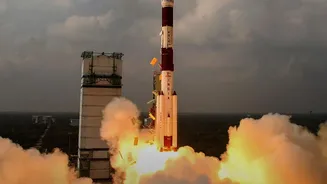
A safety system is only as good as its reliability, and ISRO has subjected the CES to a series of gruelling tests. In July 2018, the agency successfully conducted a Pad Abort Test, demonstrating the system's ability to pull the capsule away from the launch pad at zero altitude. More recently, in October 2023, ISRO performed the crucial TV-D1 mission, an in-flight abort test. A test vehicle was launched to an altitude of about 17 km, where an abort was deliberately triggered. The CES fired perfectly, pulling the crew module away from the rocket. The module then deployed its parachutes and splashed down safely in the Bay of Bengal, where it was recovered by the Indian Navy. This successful test validated the entire escape sequence under realistic flight conditions, from abort trigger to crew recovery.
The Anatomy of an Escape
If an emergency is detected, a dramatic sequence unfolds in a matter of seconds. First, pyrotechnic devices sever the connections holding the crew module to the rocket. Simultaneously, the escape motors ignite with a powerful roar, pulling the capsule away. After the motors burn out in a few seconds, the capsule coasts to a safe altitude. The escape tower is then jettisoned, and the crew module begins its descent. A series of parachutes—first smaller drogue chutes to stabilise the capsule, followed by large main parachutes—deploy to slow it down for a gentle splashdown in the ocean. This entire automated process, from detecting a failure to landing safely under a parachute, is designed to ensure the astronauts return home, no matter what happens to the rocket below.