





The Pacific's Big Temperature Swing
El Niño, Spanish for 'the little boy', is the warm phase of a larger natural climate pattern called the El Niño-Southern Oscillation (ENSO). In a normal year, strong trade winds blow from east to west across the Pacific Ocean, pushing warm surface water
towards Asia and Australia. This allows colder, nutrient-rich water to rise from the depths along the coast of South America. During an El Niño event, which occurs irregularly every two to seven years, these trade winds weaken. As a result, the large pool of warm water is no longer pushed west and instead spreads eastward, toward the coast of South America. This fundamental change in ocean temperature, sometimes just a few degrees, is enough to disrupt atmospheric patterns across the globe.
How a Warm Pacific Disrupts India's Monsoon
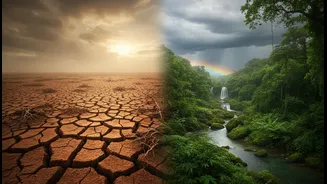
The connection between a warm Pacific and a dry India lies in the atmosphere. The Indian monsoon is a gigantic sea breeze, driven by the temperature difference between the land and the ocean. During an El Niño, the warming of the eastern Pacific shifts the region of rising warm, moist air away from the Western Pacific and Indian Ocean area. This disrupts the normal atmospheric circulation pattern, known as the Walker Circulation. For India, this typically weakens the low-pressure system over the subcontinent that is crucial for drawing in moisture-laden winds from the Indian Ocean. The result is often a weaker, delayed, or more erratic monsoon, leading to deficient rainfall across large parts of the country. Historically, many of India's most severe droughts have been linked to strong El Niño years.
From Fields to Markets: The Economic Ripple
The impact of a poor monsoon goes far beyond just the weather report. For India's economy, it's a significant threat. Agriculture, which contributes a substantial portion to the GDP and is the main source of income for nearly half the workforce, is hit hardest. Lower crop yields from rain-fed farms lead to a direct drop in agricultural output. This reduces rural incomes, which in turn dampens demand for everything from tractors to everyday consumer goods, affecting industries across the board. Furthermore, a shortfall in the production of essential food items like pulses, rice, and vegetables can lead to a sharp rise in food inflation, putting pressure on household budgets and forcing the Reserve Bank of India to manage monetary policy under difficult conditions.
Not Every El Niño Means Disaster
While the correlation is strong, an El Niño does not automatically guarantee a drought in India. The impact can be moderated by other climate factors, such as the Indian Ocean Dipole (IOD), which is a similar temperature fluctuation in the Indian Ocean. A 'positive' IOD can sometimes counter the negative effects of an El Niño and bring sufficient rain. Moreover, in recent years, structural changes in the Indian economy have helped build some resilience. Increased irrigation cover, diversification of rural incomes beyond farming, and government food grain reserves can help cushion the blow from a single bad monsoon. However, a prolonged or very strong El Niño remains a major cause for concern.
Meet La Niña: The Cooler Sibling
El Niño is only one half of the cycle. Its counterpart is La Niña ('the little girl'), which is essentially the opposite phenomenon. During a La Niña event, the trade winds are stronger than usual, pushing more warm water to the west and causing colder-than-average water to surface in the eastern Pacific. For India, La Niña is often a welcome guest. These conditions are typically associated with a stronger-than-normal monsoon, leading to abundant rainfall, and sometimes even floods. The entire cycle—El Niño, La Niña, and the neutral phases in between—is what scientists refer to when they talk about ENSO, a global climate driver whose pulse is felt keenly in every Indian farm and marketplace.