





A New Blueprint for Mars
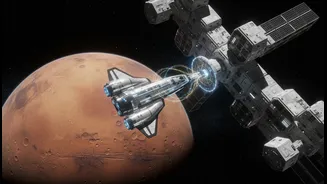
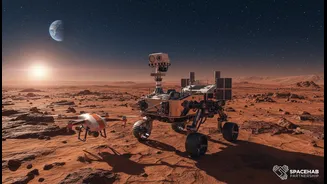
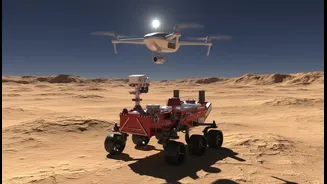
NASA's strategy is shifting from being the sole designer and operator of its Mars missions to becoming a customer. In June 2026, the agency announced a partnership with Relativity Space for a 2028 mission dubbed Aeolus. Under this new public-private model,
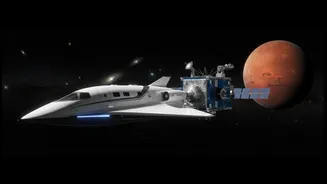
NASA provides the scientific instruments, while the private partner—in this case, Relativity Space—is responsible for the rocket, the spacecraft, and the interplanetary journey. This approach is inspired by the Commercial Lunar Payload Services (CLPS) program, where NASA buys rides to the Moon from a pool of commercial vendors. The hope is to replicate this model for the much more challenging destination of Mars, fostering an ecosystem of commercial providers that can send a steady stream of smaller, focused missions to the Red Planet.
The Promise of Speed and Innovation
The main argument for this model is that it acts as a "force multiplier for science," as NASA Administrator Jared Isaacman put it. By outsourcing the launch and transport, NASA can focus its resources on what it does best: world-class science and instrument development. Proponents believe this will dramatically increase the frequency of missions, allowing for more data collection and technology demonstrations. Instead of waiting a decade for a single, multi-billion-dollar mission, this model could enable a mission with every 26-month launch window between Earth and Mars. For the private companies, the incentive is a high-profile NASA contract that proves their deep-space capabilities, making them more competitive for future business. This symbiotic relationship aims to accelerate discovery and build a more robust industrial base for space exploration.
The Spectre of Cost Optimism
The great risk is what's known as "commercial-cost optimism." While private firms often promise innovation at lower prices, the history of aerospace is littered with projects where initial cost estimates proved wildly inaccurate once faced with technical hurdles. Fixed-price contracts, like those in the CLPS program, are designed to shift this risk to the company. However, the model has seen mixed results on the way to the Moon, with both dramatic successes and high-profile failures. Mars is an exponentially harder target. There's no established business case, no prospect of near-term resource extraction, and no existing infrastructure. The financial and technical chasm between sending a small lander to the relatively close Moon and ensuring a payload's safe arrival and operation in Mars orbit is immense.
Why Mars is a Different Beast
The challenges of Mars cannot be overstated. The distance alone creates communication delays of up to 24 minutes one-way, making real-time control impossible. The journey is longer, requiring more fuel and more robust life-support systems for any potential crewed mission. Furthermore, landing on Mars is notoriously difficult due to its thin atmosphere. This isn't like low-Earth orbit, where commercial models have thrived, or even the Moon. For Mars, there's no safety net and no rescue possible. While NASA's new partnership model is a bold experiment to supercharge exploration, its success depends on private industry's ability to navigate these unique interplanetary challenges without the safety of traditional, cost-plus government contracts. India's own Mars Orbiter Mission (Mangalyaan) stands as a powerful example of a highly successful and remarkably cost-effective government-led interplanetary mission, providing a different but proven pathway to exploration.