




A New Trick from an Old Theory
The latest breakthrough in exoplanet detection sounds like something straight out of science fiction, but it’s grounded in century-old physics. The method, known as gravitational microlensing, uses a consequence of Einstein's theory of general relativity:
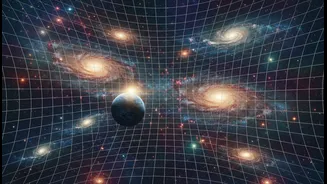
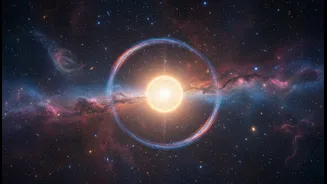
gravity warps the fabric of space-time. Imagine a bowling ball on a trampoline; that’s what a massive object like a star does to the space around it. When a foreground star perfectly aligns with a much more distant star from our vantage point, its gravity acts like a cosmic magnifying glass. This 'lens' bends and amplifies the light from the background star, causing it to temporarily appear much brighter. Astronomers have used this effect to study distant galaxies for years, but applying it to the smaller scale of planets is a more recent, and much trickier, innovation.
Finding a Planet Hiding in the Light
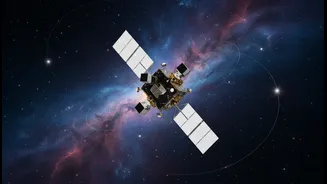
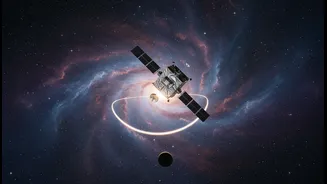
The real magic happens when the foreground star isn't alone. If that star has a planet orbiting it, the planet’s own smaller gravitational field creates a secondary, much quicker distortion in the magnified light. For a brief moment, it produces an extra 'blip' of brightness. Recently, an international team of scientists confirmed the existence of a planet named Gaia23bra b using this very method. Initial hints of the planet came from the Gaia space telescope in 2023, but its observations were too infrequent to be certain. The breakthrough came when researchers scoured archived data from NASA’s TESS satellite, which happened to be watching the same patch of sky. TESS, which takes images every few minutes, had captured the crucial planetary blip that confirmed the world's existence. It's a remarkable new use for a satellite that wasn't designed for this kind of work.
What Makes This Method Different?
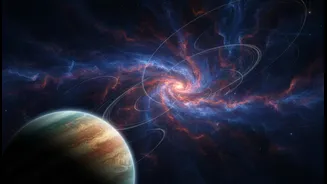
This new capability is so exciting because it finds planets that other methods typically miss. The most common technique, the transit method used by satellites like TESS and Kepler, looks for the tiny dip in a star’s light as a planet passes in front of it. This approach is fantastic for finding large planets orbiting very close to their stars. Microlensing, however, is the opposite. It is most sensitive to planets with large orbits, similar to Jupiter or Saturn in our own solar system, and can be used to find worlds thousands of light-years away. For instance, while TESS normally finds planets within a 150-light-year radius, the newly confirmed Gaia23bra b is a staggering 40,000 light-years away. These two methods are beautifully complementary, allowing astronomers to build a more complete census of the planets in our galaxy.
Not the Only Space-Time Trick
Harnessing the laws of space-time for planet hunting isn't entirely new. In fact, the very first exoplanets ever confirmed, back in 1992, were found using a different time-bending technique called pulsar timing. Pulsars are the incredibly dense, rapidly spinning remnants of massive stars. They emit beams of radiation that sweep across space like a lighthouse, and from Earth, we detect these as incredibly regular pulses. Their timing is so precise they rival atomic clocks. If a pulsar has an orbiting planet, the planet’s gravity causes the pulsar to wobble slightly. This wobble introduces a tiny, but measurable, periodic variation in the arrival time of its pulses. By decoding these timing shifts, astronomers can deduce the presence of a planet. While this method only works for the rare systems with pulsars, it demonstrates how fundamental cosmic principles can be turned into powerful discovery tools.
The Future is Bright (and Warped)
The successful use of TESS data for a microlensing discovery is more than just a single win; it’s a preview of the future. NASA's upcoming Nancy Grace Roman Space Telescope is being specifically designed to use gravitational microlensing as one of its primary planet-hunting strategies. Roman will stare at the dense, star-packed heart of the Milky Way, where microlensing events are far more common. While TESS’s discovery was a case of being in the right place at the right time, Roman will conduct a systematic survey, and scientists predict it will discover thousands of new worlds this way. It will be capable of finding everything from massive gas giants to planets smaller than Earth, giving us an unprecedented look at the true diversity of planetary systems.