





The Black Hole Family’s Middle Child
Imagine the black hole family tree. On one end, you have stellar-mass black holes, the common cousins. They're born from the collapse of single, massive stars and typically weigh a few to a few dozen times the mass of our sun. On the other end are the supermassive
grandparents, gargantuan beasts millions or even billions of times our sun's mass, found at the heart of nearly every large galaxy, including our own Milky Way. For a long time, there was a huge gap between them. Where were the 'intermediate-mass' black holes (IMBHs), weighing from a hundred to a hundred thousand solar masses? Their existence was predicted, but finding one proved incredibly difficult, earning them the title of the 'missing link' in black hole evolution.
Listening for Cosmic Collisions
So how do you find something that's invisible by definition and lurking light-years away? You don't look for it; you listen. When two black holes spiral into each other and merge, they unleash a cataclysmic burst of energy in the form of gravitational waves—ripples in the very fabric of spacetime. Observatories like LIGO in the United States and Virgo in Italy are giant, L-shaped detectors designed to sense these infinitesimal vibrations. By catching these waves, scientists can reconstruct the merger event, including the masses of the objects involved. These detectors have opened a new window onto the universe, allowing us to hear the symphony of cosmic collisions that was previously silent.
A Breakthrough Signal from the Void
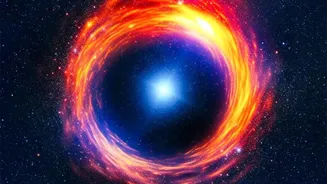
In 2019, scientists detected a signal unlike any before. Labelled GW190521, it was the echo of a collision between two hefty black holes, weighing about 85 and 66 times the mass of the sun. The colossal crash created a new, single black hole of 142 solar masses, with the remaining energy blasting into space as gravitational waves. This was a watershed moment. The resulting object was the first definitive IMBH ever observed at the moment of its birth. For the first time, scientists had hard evidence not just that IMBHs exist, but also one way they can form: through the merger of smaller, but still very large, black holes.
The Seeds of Galactic Monsters
The confirmation of IMBHs helps solve one of the biggest puzzles in astrophysics: how did supermassive black holes (SMBHs) get so big, so fast? The early universe doesn't seem to offer enough time for a stellar-mass black hole to slowly feed and grow into a billion-solar-mass giant. IMBHs offer a neat solution. They could act as the 'seeds' for SMBHs. Under this model, IMBHs form in dense star clusters and then sink to the centre of their host galaxy. There, they merge with other black holes and accrete surrounding gas, growing hierarchically over cosmic time into the supermassive behemoths we see today. Detecting IMBH mergers provides the first direct, observational evidence supporting this hierarchical growth theory.
Challenging the Stellar Playbook
The discovery did more than just fill a gap; it broke established rules. Specifically, the masses of the two black holes that created GW190521 fell into what physicists call the 'pair-instability mass gap'. According to stellar evolution theories, stars of a certain mass (roughly 65 to 120 times the sun) should die in a runaway thermonuclear explosion that blows them apart completely, leaving no black hole behind. Yet, here was evidence of an 85-solar-mass black hole, which shouldn't have been able to form from a single star. This forces scientists to rethink the final stages of massive stars' lives. Perhaps stellar collisions in dense clusters can create objects that bypass this rule, or maybe the physics of these stellar explosions is more complex than we thought.
A New Era of Cosmic Cartography
Every new IMBH detection is a new pin on a map that was previously blank. These events are providing crucial data points that refine our cosmic models, telling us how structures like galaxies form and evolve. Scientists are now re-evaluating theories of star cluster dynamics, galaxy mergers, and the very first generation of stars. Future observatories, both on the ground like LIGO-India and the proposed Einstein Telescope, and in space like LISA, will be even more sensitive. They promise to detect thousands more of these mergers, transforming IMBHs from rare curiosities into a fundamental tool for understanding the universe's most extreme and creative processes.