




As the monsoon clouds recede, India's November night sky opens up with breathtaking clarity. You don't need a powerful telescope to enjoy the show; a simple pair of binoculars is your ticket to exploring the cosmos from your own backyard or terrace.
Choosing Your First Stargazing Binoculars
Before
you can gaze upon distant stars, you need the right tool. For beginners, binoculars are a better starting point than a telescope because they are portable, affordable, and offer a wide view of the sky, which makes finding objects much easier. When you see a pair labelled '7x50' or '10x50', the first number is the magnification (7x or 10x) and the second is the diameter of the large front lenses in millimetres. Most astronomers recommend a magnification between 7x and 10x for handheld viewing; any more powerful and the natural shaking of your hands will make the image unstable. An objective lens diameter between 40mm and 50mm is ideal, as it gathers enough light to make faint objects visible without being too heavy to hold steady. Look for porro prism models, which are often recommended for astronomy, though a good roof prism pair will also work well.
Preparing for a Night of Wonder
Your viewing experience depends as much on your preparation as your equipment. First, find a good location. This means getting as far away from city light pollution as possible. Even a local park, a rooftop, or a quiet rural spot can make a huge difference. Give your eyes at least 15-20 minutes to adapt to the darkness; this will dramatically increase what you can see. November evenings in most of India are cool and pleasant, but it’s wise to get comfortable. A reclining garden chair can save you from neck strain during a long session of looking up. Finally, learn to hold your binoculars steady. Brace your elbows against your knees or a stable surface. For longer viewing, a simple tripod can be a great investment to eliminate shaking entirely.
What to Spot: The Pleiades Star Cluster
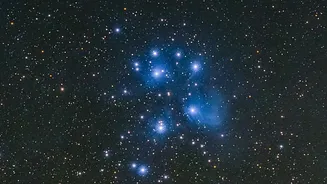
One of the most dazzling objects for any beginner is the Pleiades star cluster (M45), also known as the Seven Sisters. Visible high in the eastern sky by mid-evening in November, it's part of the constellation Taurus, the Bull. To the naked eye, it looks like a tiny, misty patch of light, almost like a miniature dipper. Through your binoculars, this fuzzy patch resolves into a stunning cluster of brilliant, blue-white stars. While often called the Seven Sisters, most people can only see six stars without aid, but binoculars will reveal dozens. A simple way to find it is to first locate the prominent constellation Orion, the Hunter, and follow the line of his three-star belt upwards and to the right. This line points towards the reddish star Aldebaran, and continuing past it will lead you straight to the Pleiades.
Your Next Target: The Great Orion Nebula
Orion, known in Indian mythology as Mruga (the Deer), is arguably the most magnificent winter constellation and it begins rising in the east in November evenings. Its most recognisable feature is the belt of three bright stars in a short, straight line. Just below this belt hangs Orion's 'sword'. To the naked eye, the middle 'star' in the sword looks a bit fuzzy. Point your binoculars there, and you will be treated to a mesmerising sight: the Orion Nebula (M42). This is not a star at all, but a vast cloud of glowing gas and dust where new stars are being born. Even from a light-polluted city, binoculars will reveal it as a ghostly, luminous cloud. From a darker site, the view is even more spectacular. It's one of the most rewarding sights for any beginner.
A Challenge: The Andromeda Galaxy
Ready to see another galaxy? The Andromeda Galaxy (M31) is the closest major galaxy to our own Milky Way and is visible to the naked eye from a dark site as a faint, elongated smudge. November offers a prime view as it's high in the sky. Finding it takes a little practice. First, locate the 'W' shape of the constellation Cassiopeia. The right side of the 'W' acts as an arrow, pointing roughly in the direction of Andromeda. Sweep this area slowly with your binoculars. What you are looking for is a small, pale, oval puff of light. Don't expect to see spiral arms; through binoculars, it appears as a soft, glowing core. The light from this smudge has travelled for 2.5 million years to reach your eyes, a truly mind-bending thought as you stand in your backyard.