
An Atmosphere Unlike Any Other
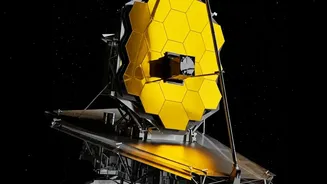
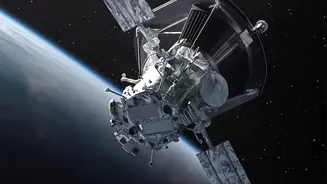
The James Webb Space Telescope has given humanity an unprecedented new sense: the ability to chemically 'sniff' the atmosphere of planets orbiting distant stars. One of its most tantalizing targets has been K2-18 b, an exoplanet 120 light-years from Earth.
This isn't just another rock in space; it's a world 8.6 times more massive than Earth, and initial studies have revealed the presence of carbon-bearing molecules, including the greenhouse gases methane and carbon dioxide. The detection of these specific gases is a monumental step, shifting our search for habitable worlds from simply locating planets in the right place to actually analyzing their atmospheric ingredients.
How Webb 'Reads' the Air
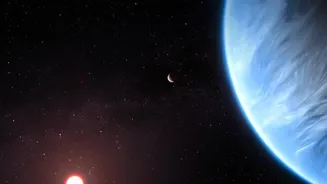
So, how does a telescope a million miles from Earth study the air of a planet it can't even see directly? The technique is called transit spectroscopy, and it's brilliantly clever. K2-18 b was discovered because it 'transits,' or passes in front of its star from our point of view, causing a tiny, detectable dip in the star's brightness. As the planet makes this pass, a fraction of the starlight filters through its atmosphere. Gases in that atmosphere absorb specific colours, or wavelengths, of light. The JWST's incredibly sensitive infrared instruments, NIRISS and NIRSpec, can analyze the starlight that reaches us, identify which colours are missing, and match those missing pieces to specific chemical fingerprints—like methane or carbon dioxide. It’s like seeing a rainbow with a few colours blotted out and knowing exactly what blotted them.
A 'Hycean' World of Possibilities
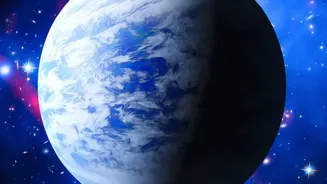
The findings on K2-18 b have led scientists to classify it as a potential 'Hycean' world—a theoretical type of planet covered by a water ocean with a hydrogen-rich atmosphere. This is a class of planet that doesn't exist in our solar system. The strong signals of methane and carbon dioxide, combined with a noticeable lack of ammonia, support the hypothesis that a vast liquid water ocean could exist beneath its gaseous envelope. Traditionally, the search for life has focused on smaller, rocky planets like Earth. But larger Hycean worlds are much easier to observe, and if they can indeed support oceans, they represent a hugely promising new avenue in the search for life.
The Tantalizing Hint of Something More
Beyond the confirmed greenhouse gases, Webb's initial observations of K2-18 b also returned a faint, possible signal of something extraordinary: a molecule called dimethyl sulfide (DMS). On Earth, the vast majority of DMS in the atmosphere is produced by life, specifically marine phytoplankton. This has sparked immense excitement and caution within the scientific community. The detection is not yet confirmed and is statistically weak, meaning it could be a measurement anomaly or have an unknown non-biological origin. However, the mere possibility has made K2-18 b one of the most compelling targets for follow-up observations. It’s not proof of life, but it is perhaps the most promising hint of a potential biosignature found to date.
The Beginning of a New Chapter
The discoveries at K2-18 b are just the beginning. The JWST is now systematically studying the atmospheres of various exoplanets, from scorching lava worlds like 55 Cancri e to temperate gas giants like TOI-199b. Each observation helps scientists build a richer understanding of planetary formation and what makes a world potentially habitable. While the data from K2-18 b is consistent with a world containing a life-sustaining ocean, it's also possible it's a gas-rich 'mini-Neptune' with no defined surface at all. Future observations with Webb’s other instruments are planned to further refine the data and hopefully confirm or rule out the presence of DMS. We are moving from an era of discovering planets to an era of characterizing them, one atmospheric scan at a time.