





The Mission and The Machine
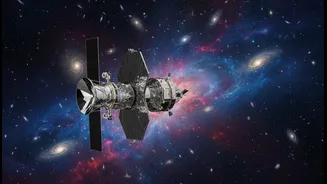
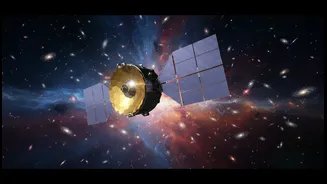
The Nancy Grace Roman Space Telescope is NASA's next-generation flagship observatory, engineered to tackle some of the biggest mysteries in astrophysics. Named after Dr. Nancy Grace Roman, the agency's first chief astronomer and the “mother” of the Hubble
Space Telescope, this mission has two primary goals: to understand the enigmatic forces of dark energy and dark matter, and to find and study exoplanets, which are planets orbiting other stars. The telescope features a 2.4-metre primary mirror, the same size as Hubble's, but its power comes from its revolutionary Wide Field Instrument (WFI). This 300-megapixel camera gives Roman a field of view at least 100 times larger than Hubble's, allowing it to create vast cosmic panoramas with stunning resolution. It will also test a new Coronagraph Instrument, designed to block the overwhelming glare of stars to directly image the faint planets orbiting them.
Launch Details: When and Where
The final countdown is approaching. The Roman Space Telescope is officially scheduled to launch on August 30, 2026. This date places the mission ahead of its original schedule, a testament to the dedicated work of the teams at NASA. The telescope will lift off from Launch Complex 39A at NASA’s Kennedy Space Center in Florida, carried into space aboard a powerful SpaceX Falcon Heavy rocket. After launch, it will travel for about 1.5 million kilometres to reach its operational orbit at the second Sun-Earth Lagrange point (L2). This gravitationally stable spot is the same region where the James Webb Space Telescope (JWST) operates, offering a cold, clear, and constant view of deep space, far from the heat and light of Earth. The spacecraft arrived at the Kennedy Space Center in late June 2026 for its final tests and fuelling before being integrated with the rocket.
A Cosmic Census Taker
Roman’s most significant contribution may be its sheer data-gathering power. While missions like Hubble and Webb excel at deep, focused studies of specific objects, Roman is built for speed and scale. It’s a survey telescope designed to systematically scan the sky. In its five-year primary mission, it’s expected to observe over a billion galaxies and billions of stars. This enormous dataset will help scientists map the distribution of dark matter and measure how dark energy has influenced the expansion of the universe over time. For planet hunters, Roman represents a paradigm shift. Astronomers forecast it could discover an astonishing 100,000 exoplanets, potentially more than every other telescope in history combined. This will move exoplanet science from an era of individual discovery into an era of demographics, helping us understand how common or rare planetary systems like our own truly are.
How Roman Differs from Webb
While both Roman and the James Webb Space Telescope are infrared observatories operating at the same L2 point, they are designed for fundamentally different jobs. Think of Webb as a microscope and Roman as a wide-angle camera. Webb’s massive 6.5-metre mirror allows it to peer deeper into space and further back in time than any other instrument, capturing highly detailed images of the universe’s first galaxies. Roman’s strength is its panoramic field of view. In a single snapshot, it can capture an area of the sky 100 times larger than Webb or Hubble can. The two missions are designed to be complementary. Roman’s wide surveys will identify countless new and interesting targets—from strange galaxies to potential Earth-like planets—that Webb can then investigate with its powerful, focused vision. Roman will provide the map, and Webb will explore the most intriguing destinations on it.