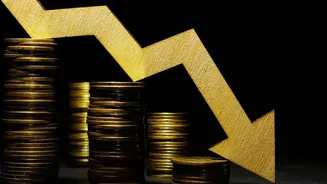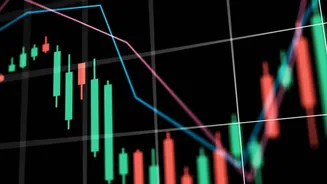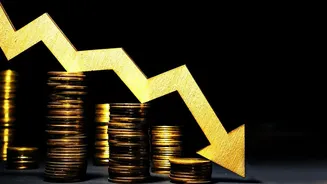





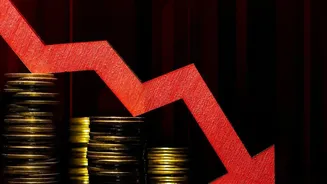
Watching the value of a gold investment fall can be a nerve-wracking experience. But before you panic, historical data offers a crucial perspective: these drops, even those of 10% or more, are not just common, they are a recurring feature.
Understanding the Drawdown
In financial
terms, a 'drawdown' is simply the measure of a price decline from a recent peak to a subsequent low. It's a way of quantifying a correction. When it comes to gold, the data is clear. Over any given multi-year period, the price of gold has frequently experienced significant pullbacks. Data since 1996 shows that the gold price has traded at least 10% below its record high more than 60% of the time. In fact, the median intra-year drop since 1980 has been around 13%. These aren't rare events; they are a baked-in characteristic of the gold market. Even years that end with strong positive returns can see scary double-digit dips along the way.
A Historical Pattern of Volatility
History is littered with examples of gold's volatility. The bull market of the 1970s, for instance, saw five separate corrections that exceeded 20%. The period from 2001 to 2011 included pullbacks ranging from 15% to 34%. More severe drawdowns of over 30% or 40% have occurred multiple times over the past 50 years, such as in 1980-82, the mid-1990s, during the 2008 financial crisis, and from 2011 to 2015. Some of these corrective periods were prolonged, with prices spending years below a previous peak. This volatility is why gold is often described as a volatile asset in the short term, prone to dramatic price swings. The key takeaway is that these episodes are not exceptions, but rather a recurring part of gold's long-term cycle.
What Drives These Price Swings?
Several powerful forces influence gold's price, often pulling it in different directions at once. A primary driver is interest rates, particularly 'real yields' (interest rates minus inflation). Since gold pays no interest, its appeal diminishes when government bonds offer higher, inflation-adjusted returns. The strength of the US dollar is another critical factor; because gold is priced in dollars globally, a stronger dollar tends to make gold more expensive in other currencies, often dampening demand. Beyond that, broad market sentiment plays a huge role. During moments of extreme financial stress, investors might initially sell liquid assets like gold to cover losses elsewhere, pushing its price down temporarily. Finally, the simple dynamics of supply and demand—from central bank buying to consumer demand for jewellery—provide a constant underlying influence.
Corrections Within Major Bull Markets
Perhaps the most crucial context for an investor is that drawdowns are not necessarily a sign that a long-term upward trend is over. On the contrary, healthy bull markets often feature sharp corrections. These pullbacks can serve to reset an over-eager market, shake out short-term speculators, and establish a new base for future growth. For example, despite a steep 20% correction at one point in 2008, gold finished the year with a 28% gain. Similarly, a 15% intra-year drop in 2020 didn't stop it from ending the year up 28%. This pattern highlights a critical distinction: a temporary correction is different from a long-term trend reversal. The fundamental reasons for owning gold, such as concerns over government debt or currency debasement, often persist long after a short-term sell-off has passed.
The Other Side: Recovery
Just as drawdowns are a regular feature, so too are eventual recoveries. Historical data suggests that periods of sharp price falls are often followed by strong returns. One analysis of the largest 90-day price drops since the year 2000 found that gold's average return 12 months later was over 13%, and its average return three years later was over 50%. Following the major drawdowns associated with crises like the 2008 financial crisis and the market turmoil in 2022, gold eventually recovered and rallied significantly. However, the timeline for this recovery can be unpredictable. Some rebounds are swift, while others have taken years to return to a previous high. This underscores that patience is often a required virtue for gold investors.