






The Problem of the Empty Throne
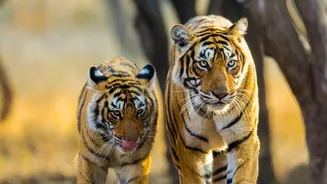
A depleted forest isn't just a place with fewer trees. It is an ecosystem out of sync. Often, this imbalance starts at the top, with the local extinction of its apex predator. In India, where tigers are a symbol of national heritage, their absence from
historical ranges due to poaching or habitat loss leaves a gaping hole. Without the tiger, the 'throne' of the apex predator sits empty, and the consequences ripple downwards through the entire food web. This leads to what ecologists call a trophic cascade, where the loss of a top predator triggers a series of negative effects throughout the ecosystem.
The Ripple Effect of a Roar
The reintroduction of a tiger does more than just add one animal back into the landscape; it kickstarts a chain reaction of ecological recovery. Tigers are a 'keystone species', meaning their presence has a disproportionately large effect on their environment. Their primary role is controlling populations of large herbivores like deer and wild boar. Without predators, these herbivore populations can explode, leading to overgrazing. They consume vegetation faster than it can regenerate, stripping the forest undergrowth bare. The mere presence of a predator, known as the 'ecology of fear', also changes herbivore behaviour, keeping them on the move and preventing them from lingering in one area for too long.
From Healthy Prey to Flourishing Flora
By keeping herbivore numbers in check, tigers allow the forest's vegetation to recover. Young saplings get a chance to grow, the understory becomes denser, and a wider variety of plant species can thrive. This renewed vegetation provides food and shelter for a host of other species, from insects and birds to smaller mammals. A healthier forest structure also improves soil quality and helps regulate water flow, benefiting entire river systems that often originate in these habitats. Essentially, protecting the tiger means protecting vast areas of forest, which in turn secures the health of countless other species under its ecological 'umbrella'.
Success Stories and Calculated Risks
Tiger translocation is a complex and high-stakes endeavour. It's not as simple as moving a cat from one park to another. Success requires immense planning, including ensuring a sufficient prey base, managing potential human-wildlife conflict in surrounding areas, and long-term monitoring. India has seen remarkable successes that serve as global benchmarks. The Panna Tiger Reserve, which had lost all its tigers by 2009, is a prime example. Through a dedicated reintroduction program involving tigers from other reserves, Panna's population has bounced back, with the reserve now housing a thriving population. Similarly, Sariska Tiger Reserve, which faced a local extinction crisis in the mid-2000s, has also seen its tiger population reborn through translocation efforts. These projects prove that with scientific rigour and political will, it is possible to turn back the clock on local extinctions.