






Why Downhill Running Is Tough on Knees
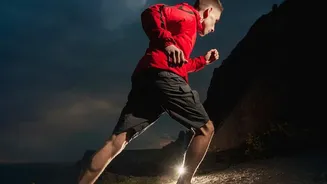
Running downhill feels like you’re getting a gravitational assist, but it places a massive strain on your body. Your quadriceps, the large muscles at the front of your thigh, act as brakes to control your descent and prevent you from tumbling forward.
This braking action is a type of muscle contraction called an eccentric contraction, where the muscle lengthens under tension. This eccentric loading is significantly more stressful on the muscle fibres and the patellofemoral joint (where your kneecap meets your thigh bone) than the shortening (concentric) action of running uphill. Without adequate strength to absorb these repetitive braking forces, the stress gets transferred to your knee joint, leading to common running ailments like patellofemoral pain syndrome, often called 'runner's knee'.
Understanding Eccentric Contractions
Every muscle movement involves three phases. Using a simple bicep curl as an example: lifting the weight toward your shoulder is the concentric phase (muscle shortens). Holding it still is the isometric phase (muscle length doesn't change). Slowly lowering the weight back down is the eccentric phase (muscle lengthens under load). When you run downhill, your quads are in a constant state of eccentric contraction, working to absorb impact and control your momentum. If your muscles are not prepared for this specific type of load, they can become fatigued and fail to properly protect the knee joint. Training eccentrically teaches your muscles and tendons to become more resilient and better at handling this stress.
The 'Slow' is the Secret
The solution is not just eccentric exercise, but slow-eccentric exercise. By intentionally slowing down the lengthening phase of a movement to three to five seconds, you force your muscles and tendons to adapt and grow stronger in a highly controlled manner. This slow, deliberate loading stimulates collagen remodeling within the tendons and builds robust muscle tissue that is more capable of absorbing impact. Research suggests that eccentric training can produce greater muscle strength gains than concentric training alone. It effectively builds a better braking system for your body, improving both your stability and your ability to handle the specific demands of downhill running, thus reducing the risk of overload injuries.
Three Essential Slow-Eccentric Exercises
Integrating these exercises into your routine two to three times a week can make a significant difference. Focus on the quality and control of the slow lowering phase. 1. Slow-Tempo Step-Downs: This movement directly mimics the motion of running downhill. Stand on a low box or a sturdy step (4-8 inches high). Keeping your weight on one leg, slowly lower the heel of your other foot to gently tap the floor. The descent should take a full 3-5 seconds. Ensure your standing knee tracks over your foot and doesn't collapse inward. Push back up to the starting position and repeat for 8-12 reps per leg. 2. Rear-Foot-Elevated Split Squats (Bulgarian Split Squats): This exercise targets the quads and glutes while challenging your stability. Place the top of your back foot on a bench or chair behind you. Keeping your torso upright, slowly lower your body until your front thigh is nearly parallel to the floor, taking 3-5 seconds for the descent. Pause briefly, then drive back up to the start. Perform 8-12 reps on each leg. 3. Slow-Tempo Goblet Squats: This is a great way to load the quads in a controlled manner. Hold a dumbbell or kettlebell vertically against your chest. With your feet shoulder-width apart, initiate the squat by pushing your hips back. Lower yourself down over 3-5 seconds until your hips are below your knees. Keep your chest up and back straight. Power back up to the starting position in one second. Aim for 10-15 repetitions.