





A Long-Distance Wake-Up Call
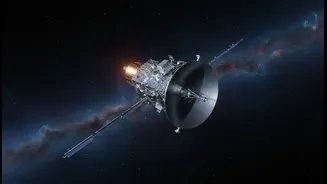
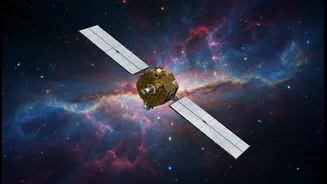
Imagine sending a text and waiting almost nine hours for a reply. That’s the reality for engineers managing pioneering spacecraft like NASA's New Horizons. After a hibernation period lasting over 300 days, the probe recently confirmed it was awake and healthy.
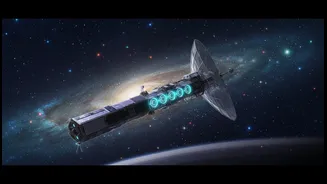
This isn't a simple nap; it's a calculated power-saving strategy. On its epic journey through the cold, dark expanse of the Kuiper Belt, far beyond Pluto, New Horizons conserves energy by putting most of its systems to sleep during long cruise phases. The wake-up call, a series of pre-programmed commands sent months earlier, brings the spacecraft back to full operational status, ready to resume its scientific duties in a region no other active mission is currently exploring.
The Need for a Digital Slumber
Why do these multi-billion dollar explorers need to hibernate? The answer lies in resource management. For probes travelling far from the Sun, solar power becomes incredibly weak. Missions like New Horizons rely on a radioisotope thermoelectric generator (RTG), essentially a nuclear battery, which provides a steady but finite amount of power as its plutonium fuel decays over time. By entering a low-power hibernation mode, mission operators can significantly extend the probe's operational lifespan. During this slumber, only essential systems—like the main computer and health-monitoring beacons—remain active. This strategy not only saves precious power but also reduces wear and tear on critical components, ensuring the probe can function for decades in the harsh environment of deep space.
Exploring the Final Frontier
The "outer boundary" is the vast, mysterious region where our Sun's influence begins to wane, and interstellar space begins. This bubble, known as the heliosphere, is carved out by the solar wind—a constant stream of charged particles flowing from the Sun. The heliosphere acts as a cosmic shield, protecting our solar system from a significant amount of high-energy galactic cosmic rays. Key boundaries define this region: the 'termination shock', where the solar wind abruptly slows down, and the 'heliopause', the theoretical edge where the solar wind is finally stopped by the pressure of the interstellar medium. Only the two Voyager probes have crossed this final frontier into interstellar space, and having another active probe like New Horizons studying this dynamic and little-understood area is invaluable.
New Data from the Cosmic Edge
With New Horizons now fully active, scientists are eager to download the data it collected even while hibernating. Instruments like its solar wind and particle spectrometers continued to gather information about the environment in the Kuiper Belt. Now awake, the probe will conduct new observations, such as using its ultraviolet spectrograph to map the distribution of hydrogen gas at the solar system's edge. This research provides a crucial 'ground truth' that helps scientists refine their models of the heliosphere's structure and how it interacts with the galaxy. The data from New Horizons, which is in a different location and part of the solar cycle than the Voyager probes, offers a unique and complementary perspective on this complex boundary.
Why It Matters for India
While missions like New Horizons are led by NASA, their discoveries belong to the world and hold particular relevance for India’s own soaring space ambitions. As the Indian Space Research Organisation (ISRO) expands its capabilities beyond lunar and Martian missions with projects like Aditya-L1 studying the Sun, understanding the heliosphere becomes critical. The data from these deep space explorers helps us comprehend the space weather environment that all satellites and future long-duration human missions must navigate. Furthermore, the engineering and operational techniques, such as power-saving hibernation, provide vital lessons for designing India’s next generation of interplanetary probes destined for Venus, Mars, and beyond. Every discovery at the cosmic frontier inspires and informs our own journey to the stars.