



A Visitor from Beyond
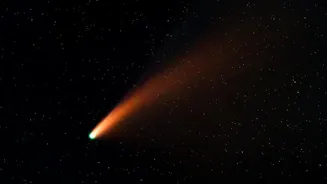
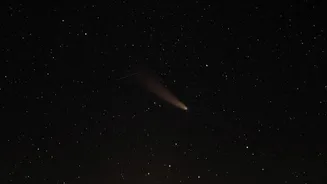
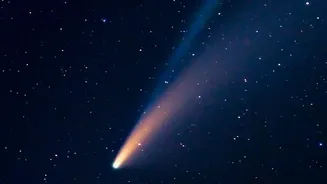
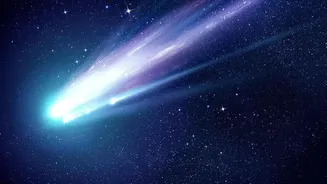
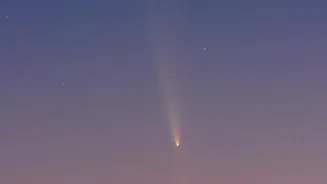
Discovered on July 1, 2025, 3I/ATLAS is only the third interstellar object ever detected passing through our solar system. The '3I' in its name literally stands for 'third interstellar'. Unlike the comets from our own neighbourhood, which are gravitationally
bound to the Sun, 3I/ATLAS is on a hyperbolic trajectory—meaning it's just passing through. It arrived, made its closest approach to the Sun in late 2025, and is now heading back out into the void, never to return. This fleeting visit provided a once-in-a-lifetime opportunity for scientists to study a physical piece of another planetary system up close.
An Unusually Pristine Messenger
Comets are often called 'time capsules' because they are leftovers from the formation of a solar system, preserving the original chemical ingredients. What makes 3I/ATLAS particularly special is its composition. Observations, most notably from the James Webb Space Telescope (JWST), revealed that it's chemically unlike any comet from our own solar system. The comet is extraordinarily rich in carbon dioxide (CO2) but has surprisingly low amounts of water. This chemical fingerprint suggests it formed in a very different environment than our own comets, providing a glimpse into the building blocks of its parent star system.
Reading the Chemical Clues
The data from JWST and other powerful telescopes allowed scientists to perform a kind of cosmic chemistry. They found that 3I/ATLAS has an extremely high ratio of deuterium, a heavier form of hydrogen, in its water. The amount was about 30 times higher than that seen in any known solar system comet. This high deuterium-to-hydrogen ratio is a key indicator of the comet's formation environment, pointing to a birthplace that was incredibly cold and potentially very ancient—perhaps even predating our own Sun. Some studies estimate the comet could be as old as 10 to 12 billion years, formed during a peak era of star formation in the galaxy.
A Tale of Two Systems
By comparing the chemical makeup of 3I/ATLAS to our own comets, scientists can start to answer fundamental questions about our place in the universe. The unique composition of this interstellar visitor suggests that the chemical conditions that led to our solar system might not be universal. The abundance of CO2 and heavy water in 3I/ATLAS indicates its home system was likely much colder and possibly formed around an older, less chemically-rich star. Each new interstellar object provides another data point, helping astronomers understand the diversity of planetary systems and whether the ingredients for planets like Earth are common or rare throughout the galaxy.
The Dawn of Interstellar Archaeology
The discoveries of 3I/ATLAS, along with its predecessors 1I/'Oumuamua and 2I/Borisov, mark the beginning of a new field: the direct study of materials from other star systems. Previously, astronomers could only study distant systems by observing the light from their stars. Now, nature is delivering physical samples to our doorstep. With new observatories like the Vera C. Rubin Observatory coming online, scientists expect to find many more of these interstellar messengers, potentially one or more per year. This growing catalogue will allow for a much broader comparison, transforming our understanding of how planets and, ultimately, life might arise across the cosmos.