


A Tantalising Signal from Afar
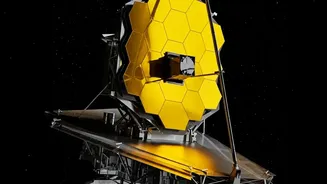
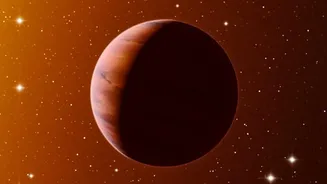
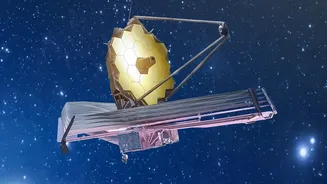
In a landmark observation, astronomers using the JWST have detected a potential signature of water vapour around a rocky 'super-Earth' named GJ 486 b, located 26 light-years away. A super-Earth is a class of planet more massive than Earth but lighter
than ice giants like Neptune. They are one of the most common types of planets in the galaxy, yet our own solar system doesn't have one, making them a key target for study. The data from JWST's Near-Infrared Spectrograph (NIRSpec) instrument showed a spectrum consistent with water vapour, a thrilling prospect. If confirmed, it would be a monumental discovery, marking the first time we have identified an atmosphere around a rocky exoplanet and opening a new chapter in planetary science.
A Major Scientific Puzzle
However, the scientific community remains cautiously optimistic. The planet GJ 486 b is incredibly hot, with a surface temperature estimated at 430 degrees Celsius, so it is in no way habitable. More importantly, the water vapour signal could be an astronomical illusion. The planet orbits a red dwarf star, which is known to have cool spots on its surface that are rich in water. Researchers have raised the possibility that the signal JWST detected came from the star itself as the planet passed in front of it, rather than from a planetary atmosphere. Distinguishing between these two scenarios is the next critical step for researchers, highlighting the meticulous process required to confirm such an extraordinary claim. The current data is confounding, leaving scientists at the very edge of a major breakthrough.
A Galaxy of Diverse Atmospheres
The search for water is not limited to just one target. The headline-making capabilities of the JWST have revealed a stunning diversity of atmospheres across the galaxy. For instance, the telescope studied the 'mini-Neptune' GJ 1214 b, a world blanketed in a thick haze that stumped previous observatories. JWST pierced through this veil to find strong evidence of a steamy atmosphere, potentially containing significant amounts of water, though the planet is too hot for liquid oceans. In stark contrast, another super-Earth, 55 Cancri e, was revealed to be a scorching lava world. Instead of water, its atmosphere is likely composed of carbon monoxide and carbon dioxide, probably being replenished by a vast ocean of magma on its surface. These differing findings show that 'rocky world' does not mean 'Earth-like'.
How Webb Sees the Unseen
These discoveries are made possible by a technique called transmission spectroscopy. When an exoplanet passes, or transits, in front of its host star, a tiny fraction of the starlight filters through the planet's atmosphere. The gases in that atmosphere absorb specific wavelengths of light, leaving a unique chemical fingerprint. JWST's powerful instruments are exceptionally sensitive to these fingerprints, particularly in the infrared spectrum of light. This allows it to identify molecules like water, methane, and carbon dioxide from trillions of kilometres away. It is this technological prowess that allows astronomers to characterise worlds that we will never physically visit, turning faint points of light into distinct places with their own unique chemistry and climate.