






Why Your Food Is Getting a New Look
The Food Safety and Standards Authority of India (FSSAI) is set to introduce a significant change in how nutritional information is displayed on packaged foods. The goal is to implement Front-of-Pack Labelling (FoPL), a system designed to give consumers
a quick, at-a-glance understanding of a product's health profile. This move is a response to the growing public health challenge of non-communicable diseases (NCDs) like obesity, diabetes, and heart conditions, which are often linked to diets high in unhealthy fats, sugars, and salt. For years, detailed nutritional information has been available on the back of packages, but these tables can be confusing and are often overlooked by busy shoppers. The new FoPL system aims to bring the most critical information right to the front.
From Stars to Warnings: The New Label Design
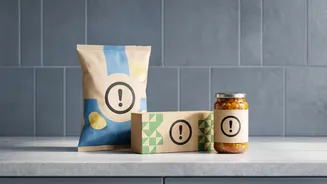
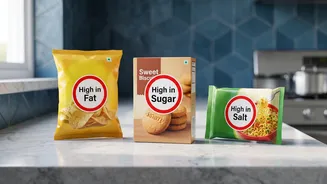
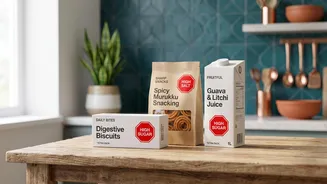
The FSSAI has considered various formats for these labels over the years. An earlier proposal was the 'Indian Nutrition Rating' (INR), a star-rating system from half a star (least healthy) to five stars (healthiest), similar to energy ratings on appliances. However, recent proposals submitted to the Supreme Court indicate a shift towards a more direct warning label system. The latest proposed design features a prominent red hexagon on a white background. If a product exceeds the set limits for salt, sugar, or added fat, this hexagon will appear on the front, clearly stating which nutrient is high. A single product can have warnings for one, two, or all three nutrients within the same hexagon if it crosses multiple thresholds.
What Counts as 'High' in Salt, Sugar, and Fat?
The warnings are not arbitrary. They are based on specific thresholds proposed by FSSAI, drawing from the Dietary Guidelines for Indians, 2024, prepared by the Indian Council of Medical Research (ICMR). According to recent draft notifications, the limits distinguish between solid foods and liquids. For solid foods (per 100g), a warning would be triggered by more than 4.2g of added fat, more than 3g of added sugar, or more than 0.625g of salt. For liquid foods (per 100ml), the thresholds are more than 1.5g of added fat, more than 2g of added sugar, or more than 0.175g of salt. Even if a product is high in just one of these nutrients, it will be required to carry the warning label.
How This Will Change Your Grocery Shopping
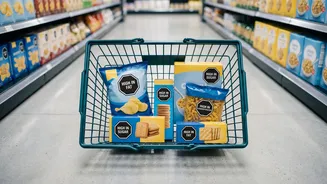
The primary goal of these labels is empowerment. When you're in a supermarket aisle comparing two brands of biscuits or instant noodles, the red hexagon will serve as an immediate visual cue. It can help you make a quicker, more informed choice without having to squint at the fine print on the back. This is especially useful for parents trying to choose healthier options for their children. The system is designed to simplify complex nutritional data into a straightforward warning. Over time, it is hoped that this will not only guide consumer choices but also encourage food manufacturers to reformulate their products to create healthier versions that avoid the warning label.
The Road Ahead and Global Context
India is not the first country to implement such a system. Countries like Chile have used similar prominent warning labels with success, leading to changes in consumer purchasing habits and product reformulations. The FSSAI has proposed a single-phase rollout for the new labels. Following a period of public and stakeholder consultation, the regulator estimates it will take about four months to finalise the regulations. After the final notification, a voluntary compliance period of 365 days has been proposed to allow food businesses to transition without causing major commercial disruption due to existing packaging stock. The Supreme Court has been actively overseeing the timeline, urging the FSSAI to implement these crucial health measures without unnecessary delay.