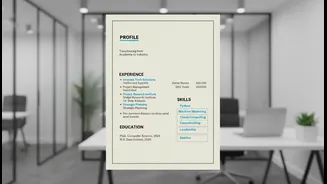









The CV vs. The Resume: Two Different Worlds
The first step in making the leap from academia to industry is understanding that the document that has defined your career so far is not built for your new destination. An academic Curriculum Vitae (CV) is a comprehensive, multi-page record of your entire
scholarly life: every publication, conference presentation, grant, and teaching assignment. Its purpose is to demonstrate a depth of knowledge and a sustained contribution to a specific field. In contrast, an industry resume is a concise marketing document, typically one to two pages, designed to do one thing: show a hiring manager you can solve their company's problems. Recruiters often spend only seconds scanning each application, looking for relevant skills and measurable impact. Your exhaustive list of publications means less than your ability to manage a project or analyze data for business insights.
From Publications to Project Management
Hiring managers outside of academia may not grasp the significance of a paper in a top-tier journal, but they understand project management, data analysis, and leadership. The key is to reframe your academic experience in the language of business. Your dissertation wasn't just a long paper; it was a multi-year, self-directed project that required critical thinking, problem-solving, and meeting deadlines. Grant writing demonstrates an ability to develop proposals and manage budgets. Peer-reviewing articles for a journal is a form of quality assurance and collaborative feedback. Instead of just listing your research topics, describe the skills you used. Focus on how you identified a problem, designed a methodology to solve it, analyzed the results, and communicated your findings.
The Art of Quantifying Your Achievements
In business, numbers speak louder than words. While your academic work might feel qualitative, you can and should quantify your accomplishments to show tangible impact. Instead of saying you “mentored students,” state that you “mentored and trained 5 junior researchers, leading to a 20% increase in lab productivity.” Instead of “secured a research grant,” write “secured a ₹50 lakh grant by developing a compelling research proposal.” Other quantifiable metrics include the number of people who attended an event you organized, the size of datasets you analyzed, or any efficiency improvements you introduced into a process. This approach provides concrete evidence of your capabilities and helps recruiters understand the scale of your contributions.
Speak Their Language: Ditch the Jargon
One of the quickest ways to lose a recruiter's interest is to use academic jargon they don't understand. Your resume must be accessible to a non-specialist audience. For example, instead of describing a niche biochemical process, explain that you “developed a new, cost-effective technique for producing advanced materials with applications in energy storage.” Go through your CV and ruthlessly eliminate any term that wouldn't be clear to someone outside your specific field. Describe your work in terms of its practical application or business value. Highlighting your teaching experience can showcase your ability to explain complex concepts to diverse audiences, a highly valued skill in any corporate environment.
What to Cut and How to Structure It
Transitioning to a resume means being selective. Long lists of publications, conference talks, or minor academic committee roles should be trimmed or cut entirely unless they are directly relevant to the job. Start your new resume with a strong professional summary—a few sentences that outline your core expertise and career goals, tailored to the role. Use a clean, reverse-chronological format that is easy for both human recruiters and Applicant Tracking Systems (ATS) to scan. Use action verbs to start your bullet points, like "managed," "analyzed," "developed," or "led," to create a dynamic and impactful document. The goal is no longer to present a complete history, but to build a powerful, targeted argument for why you are the best candidate for this specific job.