







Deep beneath the Swiss-French border, scientists are peering into a hidden reality called the 'zeptoverse'. Using the world's largest machine, they just found evidence for an event so rare it's like winning the lottery. Here's why it matters.
The World's Biggest Machine Gets an Upgrade
At the heart
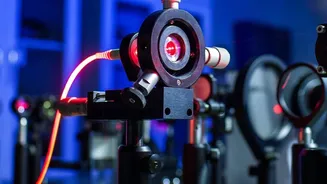
of this discovery is the Large Hadron Collider (LHC) at CERN, a 27-kilometer ring where protons are smashed together at nearly the speed of light. Specifically, the breakthrough comes from the LHCb experiment, one of four major detectors at the facility. Recently, the LHCb detector was upgraded, allowing it to collect data up to five times faster than before. This upgrade, which includes a hyper-precise silicon pixel detector called the Vertex Locator, sits just five millimeters from the particle beams, giving it an unparalleled view of the chaos inside. This new level of sensitivity is what allowed scientists to finally catch a glimpse of a particle interaction they've been hunting for over 40 years.
Hunting for a One-in-Ten-Billion Event
The focus of the search is a subatomic particle containing a 'beauty quark'. These particles are fascinating because they are incredibly unstable, existing for just a trillionth of a second before transforming, or 'decaying', into other, more stable particles. Physicists have long predicted an extremely rare decay process where a specific type of beauty particle (a Bd meson) transforms into two muons, which are heavier cousins of the electron. The Standard Model of particle physics—our current best theory for how the universe works—predicts this specific decay happens only once in every ten billion beauty particles. After decades of searching, the upgraded LHCb experiment has now found the first single-experiment evidence for this elusive event.
What 'Unprecedented Precision' Really Means
In particle physics, finding something isn't as simple as just seeing it. Scientists need to collect enough data to prove their observation isn't a random fluke. The gold standard for a 'discovery' is a statistical significance of five-sigma, but the threshold for 'evidence' is three-sigma. The new result, combining old and new data, reached a significance of 3.2 sigma, comfortably clearing the bar for evidence. This precision is the key. By precisely measuring these incredibly rare events, physicists can test the predictions of the Standard Model with immense accuracy. If the measured rate of decay is even slightly different from the predicted rate, it could be a flashing signpost pointing toward 'new physics'—undiscovered particles or forces that our current theories don't account for.
Knocking on the Door of the 'Zeptoverse'
So far, the measurements align with what the Standard Model predicts, which is itself an impressive confirmation of the theory. However, this new capability pushes physics into a new realm scientists are calling the 'zeptoverse'—an energy scale of unbelievably small distances, a billionth of a trillionth of a meter. It is at this scale that many theories predict new particles, like those that could make up dark matter, might be hiding. While this result doesn't reveal new particles directly, it drastically narrows the hiding places for them. By confirming the Standard Model's predictions with such high precision, scientists can rule out certain alternative theories and focus their search for the answers to some of the biggest questions in science, like why there is more matter than antimatter in the universe.