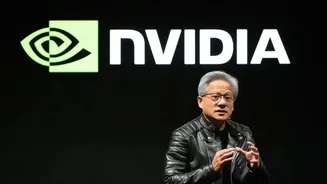







The recent, breathtaking plunge in AI-related stock prices has sent a chill through global markets, leaving investors to wonder if the AI boom is over. But a closer look suggests this isn't a collapse, but a sharp, perhaps necessary, repricing.
A Sea of Red Across Global Markets
The past
week has been brutal for anyone invested in the artificial intelligence trade. Major stock indexes from Asia to Europe followed Wall Street's steep declines, with tech-heavy benchmarks taking the biggest hit. The Nasdaq 100, home to many of the world's leading tech giants, plunged into a technical correction, with trillions of dollars wiped from global stock market valuations in a single day. Semiconductor stocks, which form the backbone of the AI industry, were at the epicentre of the rout. Companies like Nvidia, Broadcom, and AMD saw their shares plummet, with the Philadelphia Semiconductor Index suffering one of its worst days on record. The sell-off was widespread, impacting markets in Japan, South Korea, and across Europe, where even companies loosely connected to the AI supply chain, like Dutch equipment maker ASML, felt the pressure.
The Great Repricing
So, what caused this sudden shift in sentiment? The trigger appears to be the results of the U.S. midterm elections, where Democratic victories have led investors to anticipate tighter regulations on the AI industry, particularly around the construction of massive, power-hungry data centers. This political shift compounded existing anxieties about sky-high valuations, the immense cost of AI infrastructure, and when these massive investments will actually start paying off. As one analyst put it, investors stopped rewarding the AI buildout and started asking when it pays back. UBS CEO Sergio Ermotti noted that investors had been pricing in 'perfection' for the AI sector, making a sharp correction almost inevitable when expectations adjust. This isn't necessarily a sign that the AI story is over, but rather that the market is repricing the risks and timelines involved.
Fundamentals Remain Strong
Despite the market turmoil, many analysts argue that the fundamental case for AI technology remains strong. The sell-off is seen more as a 'positional' correction in a crowded trade rather than a response to deteriorating fundamentals. Corporate adoption of AI continues to accelerate globally. A recent McKinsey survey showed that nearly nine in ten organizations use AI in some capacity, and a growing number are scaling it across the entire enterprise. Projections show the enterprise AI market growing into a more than $150 billion industry by 2030, driven by the real-world value it delivers in efficiency, automation, and data-driven decision making. Companies that have successfully integrated AI are reporting significant productivity gains, and the technology is becoming an essential part of business infrastructure. This underlying adoption provides a strong counter-narrative to the idea of a total AI collapse.
Hype Versus Reality
The recent volatility highlights the crucial difference between shortterm market hype and longterm technological progress. The AI stock boom of the last few years was fueled by a powerful narrative of unstoppable growth, causing some valuations to become detached from reality. The current selloff is a painful but orderly repricing of those expectations. Analysts caution against both panic selling and rushing to 'buy the dip', advising investors instead to focus on the financial strength and earnings visibility of individual companies. The core question has shifted from how fast AI demand can grow, to how much capital that growth will consume and what the realistic returns will be. While the road ahead may be volatile, the longterm trend of AI integration into the global economy appears intact. A more measured pace of investment could even be healthy, easing pressure on supply chains and allowing for more sustainable growth.