





Vrikshasana, or Tree Pose, looks simple but is a profound test of balance. The secret to a steady, graceful pose isn't force; it's a journey. Mastering it comes from embracing gradual progression and listening to your body every step of the way.
Understanding the Roots of Balance
Before
lifting a foot, it helps to understand what balance is. It’s a skill, not a fixed state. It relies on proprioception—your body's internal GPS that senses its position in space. In yoga, this 'sixth sense' is everything. It involves a constant conversation between sensory receptors in your muscles and joints, your inner ear, and your visual system. Tree Pose challenges this system by narrowing your base of support to one foot. Wobbling isn't failure; it's your body learning and making micro-adjustments. A steady gaze, or 'drishti', provides a crucial visual anchor, calming the mind and body.
Variation 1: The Supported Kickstand
This is the ideal starting point for building a solid foundation. Begin in Mountain Pose (Tadasana), feeling grounded through both feet. Shift your weight onto one leg. Then, bend the other knee and place the sole of that foot against your standing ankle, with the toes resting on the floor like a kickstand. This provides maximum stability while allowing you to practice key alignment principles: engaging the standing leg without locking the knee, keeping the hips level, and lengthening the spine. Even here, you are training your body to find its center of gravity over a smaller base. Use a wall for support if needed.
Variation 2: Foot on the Calf
Once the kickstand feels steady, you can progress by lifting the foot entirely off the floor. From your starting position, place the sole of your lifted foot onto the inner calf of your standing leg. The most important rule in all of Tree Pose is to never place the foot directly on the knee joint. The knee is not designed to handle lateral pressure. Placing the foot on the muscular calf is a safe and effective way to increase the balance challenge. Focus on the active press between your foot and your calf; this oppositional force creates stability.
Variation 3: The Classic Tree Pose
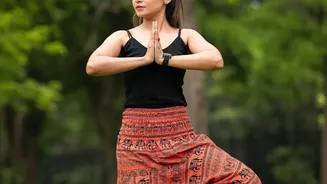
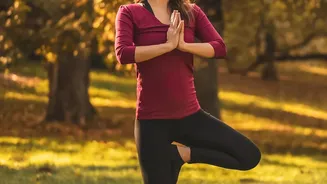
This is the full expression of Vrikshasana for many practitioners. In this variation, you guide the foot to the inner thigh of the standing leg. This requires greater hip mobility in the lifted leg and more strength in the standing leg's hip stabilizers to keep the pelvis level. Press the foot firmly into the thigh and the thigh back into the foot. Bring your hands to a prayer position at your heart. Focus on your breath; steady breathing leads to a steady body. Hold for a few breaths, gradually increasing the duration as you gain confidence.
Variation 4: Growing Your Branches
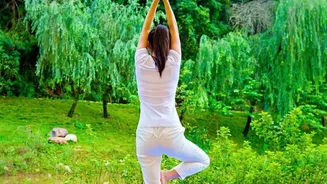
Once your base is stable, you can play with arm variations to challenge your balance further. Raising your arms overhead like branches changes your center of gravity, forcing your core and standing leg to work harder. You can bring palms together overhead or keep them apart. Another variation is to sway the arms gently, like a tree in the wind, which adds an element of dynamic movement and requires even greater core control to stay centered.
Variation 5: The Ultimate Proprioception Test
For a significant challenge, try practicing your steadiest Tree Pose variation with your eyes closed. Since our sense of balance relies heavily on visual feedback, removing it forces your body to depend entirely on proprioception—the internal signals from your feet, ankles, and core. Start by practicing near a wall for safety. You will likely feel much more wobbly, and that's the point. This deepens your internal body awareness and can dramatically improve your balance over time.