





The Universe's Greatest Mystery
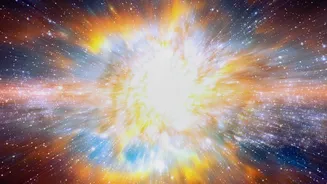
Imagine throwing a ball into the air, only to see it speed up and fly away into space instead of falling back down. That's essentially what our universe is doing. For decades, scientists expected that the gravitational pull of all the matter in the cosmos
would gradually slow down the expansion that began with the Big Bang. But in the late 1990s, observations revealed the opposite was happening: the expansion is speeding up. To explain this, scientists proposed the existence of 'dark energy', a mysterious, repulsive force that acts against gravity. This force is thought to make up roughly 70% of the entire universe, yet we know almost nothing about what it is or where it comes from. Solving the puzzle of dark energy is crucial to understanding the past, present, and ultimate fate of our cosmos.
An Unconventional Telescope
Enter the Canadian Hydrogen Intensity Mapping Experiment, or CHIME. Located in British Columbia, Canada, CHIME doesn't look like a conventional telescope. Instead of a large, steerable dish, it consists of four stationary, 100-metre-long metal half-pipes that resemble snowboarding ramps. This unique design means it has no moving parts, a key factor in its cost-effectiveness. As the Earth rotates, CHIME scans a huge strip of the northern sky every single day, collecting a massive amount of data. While it's also famous for detecting hundreds of mysterious Fast Radio Bursts (FRBs), one of CHIME's primary missions is to create a vast, three-dimensional map of the universe to hunt for clues about dark energy.
Listening for Ancient Cosmic Echoes
So how does a stationary telescope measure cosmic expansion? Instead of tracking individual stars or galaxies, CHIME listens for the faint radio glow of hydrogen, the most abundant element in the cosmos. Specifically, it looks for a pattern known as Baryon Acoustic Oscillations (BAO). Think of these as frozen 'echoes' from the early universe. In the hot, dense plasma that existed shortly after the Big Bang, sound waves rippled outwards from dense spots. When the universe cooled and became transparent, these waves 'froze', leaving a faint imprint on the distribution of matter — a standard, predictable distance between galaxy clusters. This pattern acts as a 'standard ruler'. By measuring the apparent size of this ruler at different points in cosmic history, scientists can precisely map the universe's expansion rate over billions of years.
Big Science on a Budget
CHIME's method, known as Hydrogen Intensity Mapping, is what makes it a game-changer. Traditionally, mapping cosmic structures required expensive surveys that meticulously observed the light from individual galaxies, a process that can cost millions more and take a very long time. Furthermore, those surveys could only probe regions dense enough for stars to form. CHIME's approach is much faster and more economical. By measuring the combined radio glow from vast clouds of hydrogen, it can survey a much larger volume of the universe without needing to resolve individual galaxies. A recent breakthrough confirmed that CHIME can now make these measurements on its own, without relying on data from other, more expensive telescopes to calibrate its findings. This standalone capability makes it a faster and more affordable tool for cosmology.
What This Means for the Future
The ability to affordably and rapidly map the universe opens up new possibilities. It democratizes the study of dark energy, allowing more researchers to test competing theories about its nature. Is dark energy a constant force, or has it changed over time? CHIME's data will help answer these fundamental questions. By creating the largest-volume map of the universe to date, the experiment will provide a crucial new dataset for understanding how galaxies form and evolve. While it has not yet solved the mystery of dark energy, CHIME has proven its innovative technique works. It represents a powerful new step in our quest to understand the force that is shaping the destiny of our universe.