


SUPPORTED: It's A Giant Radio Telescope in Space
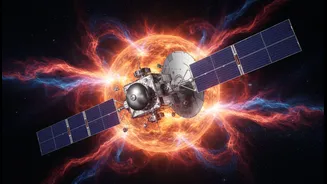
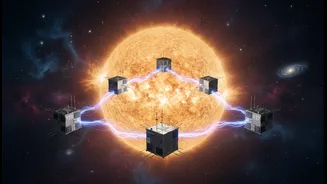
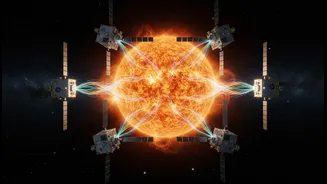
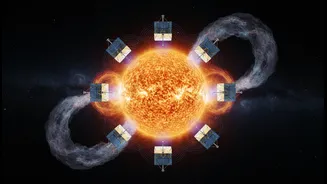
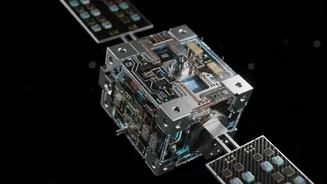
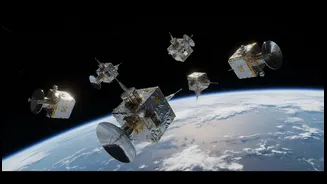
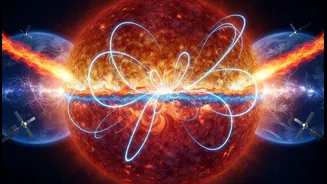
The fundamental concept behind the Sun Radio Interferometer Space Experiment (SunRISE) is solid and based on proven techniques. The mission consists of six small satellites, each about the size of a toaster oven, flying in a loose formation about 22,000
miles above Earth. Together, they will function as one massive, virtual radio telescope stretching roughly 10 kilometers (or 6 miles) wide. This technique, known as interferometry, combines data from multiple smaller antennas to simulate a single, much larger one. This is necessary because the low-frequency radio waves SunRISE is designed to study are blocked by Earth's ionosphere, making them impossible to observe from the ground. By placing this virtual telescope in space, scientists can finally access this crucial, unexplored part of the sun's radio spectrum.
SUPPORTED: It Will Create 3D Maps of Solar Bursts
One of the primary, evidence-backed goals of SunRISE is to create the first-ever 3D maps of where solar radio bursts originate in the sun's corona. These bursts, known as Type II and Type III radio emissions, are linked to the acceleration of energetic particles during solar events like coronal mass ejections (CMEs). By pinpointing the location and tracking the movement of these radio sources, scientists can gain unprecedented insight into the physics of solar storms. The data will help researchers understand what triggers these massive particle acceleration events and how they evolve as they travel from the sun out into space, which is a key objective for heliophysics.
UNSUPPORTED: It Can Predict All Solar Flares Perfectly
While SunRISE will dramatically improve our understanding of space weather, it is not a crystal ball for predicting every solar flare. The mission is designed to study the radio emissions that often precede the arrival of a solar particle storm at Earth. These radio waves travel at the speed of light, arriving before the slower-moving energetic particles, thus providing a potential early warning. However, its primary role is to understand the mechanisms of particle acceleration, not to provide pinpoint, long-range forecasts for every type of solar activity. Scientists hope the data will lead to better prediction capabilities in the future, but SunRISE itself is an investigatory tool, not an operational, all-seeing prediction engine.
SUPPORTED: It Will Help Protect Astronauts and Technology
The science goals of SunRISE have very practical applications. Solar particle storms and CMEs can pose a significant threat to our technologically dependent society. These events can damage satellites, disrupt GPS and communication signals, and even bring down power grids on Earth. For astronauts, particularly those on future long-duration missions to the Moon or Mars, these radiation storms are a major health hazard. By helping scientists better understand what causes these storms and how to track their progression, SunRISE will provide crucial data to improve space weather forecasting, ultimately helping to protect both our infrastructure on Earth and our explorers in space.
UNSUPPORTED: It Will Take Pictures of the Sun's Surface
It's important to clarify that SunRISE is not a camera in the traditional sense. It will not be taking optical images of the sun's fiery surface like other observatories such as the Solar Dynamics Observatory. SunRISE is a radio telescope. Instead of visible light, it detects low-frequency radio waves. The "maps" it creates will be radio-based, showing the location and intensity of radio emissions against the backdrop of the sun's corona. These are invisible to the human eye and will be represented visually by scientists through data processing. So, while it will "image" the sun, it will be in a part of the electromagnetic spectrum far removed from the visible light we associate with photographs.