


The Basic Blueprint for Life
At its core, the search for life starts with a simple checklist derived from our own existence. Scientists generally agree on a few non-negotiables for life as we know it: liquid water, an energy source, and the presence of essential bio-elements like
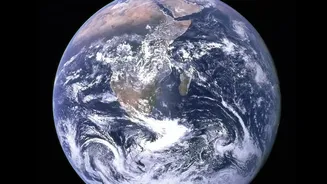
carbon, hydrogen, and nitrogen. This is the foundation of the 'habitable zone' concept — the orbital band around a star where a planet could maintain liquid water on its surface. Earth sits comfortably in our sun's habitable zone, making it the perfect model. Water acts as a universal solvent, transporting nutrients and facilitating the chemical reactions that drive biology. An energy source, whether from a star like our sun or from a planet's internal heat, provides the power needed for life's processes.
A Planet's Life Support Systems
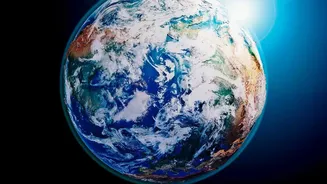
But a habitable world needs more than just water and light. Earth has crucial support systems that make it a stable home for life. A substantial atmosphere traps heat, shields the surface from harmful radiation, and provides the necessary pressure to keep water from boiling away into space. Equally vital is a magnetic field, generated by the motion of molten iron in our planet's outer core. This invisible shield deflects the solar wind, a stream of charged particles from the sun that would otherwise strip away our atmosphere and bombard the surface. Furthermore, many scientists believe plate tectonics play a key role in long-term habitability by regulating the climate through the carbon cycle and creating diverse environments.
Lessons from Earth's Deep Past
Crucially, Earth hasn't always looked the way it does today. For billions of years, our planet was a very different place, and studying its history expands our definition of a 'habitable' world. The earliest life forms thrived in an atmosphere with very little oxygen. This tells astrobiologists not to limit their search to planets with oxygen-rich skies. Instead, they might look for planets that resemble an ancient, 'Eoarchean' Earth. Recent research also suggests that plate tectonics, while important for sustaining life long-term, may not have been necessary for life to emerge in the first place. For its first billion years or so, Earth may have had a 'stagnant lid' crust, a condition that could still allow for life's origin, meaning even more types of exoplanets could be candidates in our search.
Life on the Edge: The Extremophiles
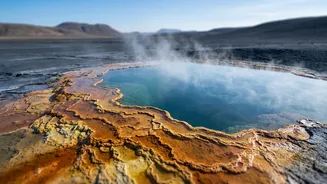
Perhaps the most profound lesson Earth teaches us comes from its 'extremophiles' — organisms that thrive in conditions humans would find unsurvivable. Scientists have found microbes in boiling hot springs, deep-sea hydrothermal vents, acidic rivers, and even frozen solid in Arctic permafrost. These resilient life forms have dramatically broadened our understanding of the limits of life. They show that life can exist at blistering temperatures above 100°C and well below freezing, and in crushing pressures or high-radiation environments. The existence of extremophiles suggests that life could potentially take hold in subsurface oceans on moons like Europa or in the methane lakes of Titan, places once considered utterly inhospitable.
Searching for the Chemical Fingerprints
Ultimately, the search for extraterrestrial life is a search for 'biosignatures'. A biosignature is any substance, feature, or phenomenon that provides evidence of past or present life. This could be a fossil, a complex organic molecule, or certain gases in a planet's atmosphere that are unlikely to exist without biological activity. For example, the simultaneous presence of gases like oxygen and methane in an atmosphere is a strong potential sign of life, as these gases would normally destroy each other. Using powerful tools like the James Webb Space Telescope, scientists can analyze the light passing through exoplanet atmospheres to look for these tell-tale chemical imbalances, using Earth's atmospheric composition as a key reference point.