
The First Glimmer of Discovery
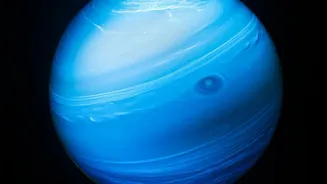
The journey to charting a new orbit begins with finding the object itself, a task of immense patience and technological power. For S/2023 U1, the first new moon found around Uranus in over two decades, the discovery was made using the powerful Magellan
telescopes in Chile. Astronomers, led by Scott S. Sheppard, didn't just point and shoot. They took a series of long-exposure images over several hours on the same night. This technique allows the faint, reflected sunlight from a tiny, distant object to accumulate on the telescope's sensor. The result is then put through what Sheppard calls "special image processing" to filter out the overwhelming glare from the planet and separate the motion of a potential moon from the static points of background stars. It’s a digital needle-in-a-haystack search, where a barely-there speck of light could be the next major finding.
Playing Celestial Connect-the-Dots
Spotting a faint dot once isn't enough; it could be a sensor glitch or a passing asteroid. To confirm a moon, astronomers must prove it's gravitationally tied to the planet. This requires playing a long game of celestial connect-the-dots. After the initial sighting in November 2023, the team observed the object again a month later to confirm its movement was consistent with a body orbiting Uranus. Seeing the object move against the background stars over time is the key confirmation step. With just a few data points, collaborators at places like NASA's Jet Propulsion Laboratory can develop a preliminary prediction of the moon's orbit. This is where the real detective work begins, as a predicted path allows astronomers to hunt for the object in a much more targeted way.
Searching Through Time
With a rough orbital path calculated, scientists can turn into digital archaeologists. They scour archival data—images taken months or even years earlier—to see if the moon was accidentally captured in previous observations. For S/2023 U1, Sheppard was able to find the moon in images he had taken back in 2021 with both the Magellan and Subaru telescopes. Finding these older data points is the gold standard for orbital calculation. An orbit determined from observations spanning a few weeks is a good guess; an orbit confirmed with data stretching over several years becomes a certainty. It dramatically improves the accuracy of the orbital model, transforming a shaky hypothesis into a confirmed path. In a similar hunt for a Neptune moon, astronomers were able to trace it back to a faint object spotted nearly two decades earlier but lost before it could be confirmed.
The Physics of the Path
Once enough positions are collected, the raw data is fed into computer models grounded in the fundamental laws of physics. The work of Johannes Kepler and Isaac Newton forms the backbone of these calculations. Kepler's laws describe the shape of the orbit—an ellipse, not a perfect circle—and how the moon's speed changes as it gets closer to or farther from Uranus. Newton's law of universal gravitation provides the mathematical engine to make sense of it all. Computers run complex simulations, testing countless possible elliptical paths to find the one that best fits all the observed data points. The result is a set of orbital elements that define the moon's path: its average distance, the shape of its ellipse (its eccentricity), and its tilt relative to the planet's equator. For S/2023 U1, this process revealed a long, 680-day journey around its parent planet.
Why These Faint Moons Matter
Studying these faint, faraway moons is more than just an astronomical accounting exercise. Their distant, eccentric, and tilted orbits suggest they were not formed alongside Uranus but were instead captured objects from the early solar system. They are like frozen time capsules, offering clues about the chaotic environment when the giant planets were still forming. Furthermore, S/2023 U1's orbit is similar to two other Uranian moons, Caliban and Stephano. This suggests they are all part of a "family," likely fragments of a single, larger parent moon that was shattered by a collision with a comet or asteroid long ago. Each new discovery helps piece together the violent and dynamic history of our own cosmic neighbourhood.