


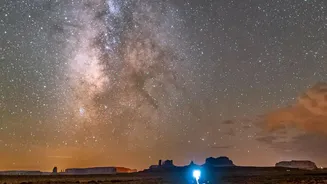

A Sanctuary from Light Pollution
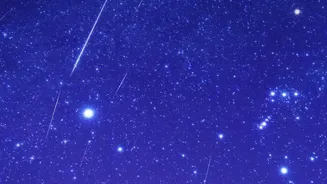
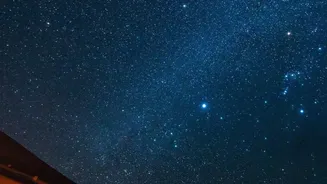
For more than 80% of the world's population, the night sky is no longer truly dark. Artificial light from cities and towns creates a phenomenon called 'skyglow', a luminous blanket that obscures stars, planets, and galaxies. This light pollution not only
disconnects us from the universe but also severely hampers astronomical research, making it difficult to observe faint celestial objects. In response, a global movement has emerged to create 'Dark Sky Places'—protected areas where artificial light is strictly controlled to preserve the natural darkness. These reserves are sanctuaries for both science and nature, allowing the cosmos to be seen in its full, unobscured glory.
Why Hanle is India's Cosmic Treasure
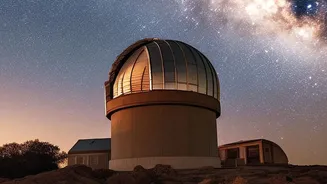
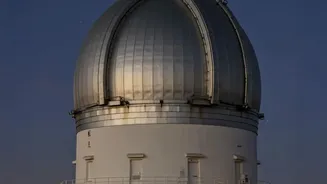
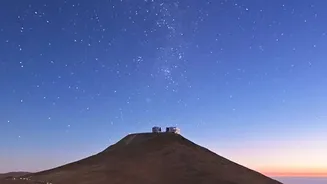
Nestled in the Changthang region of eastern Ladakh, the village of Hanle is uniquely suited to be India's astronomical capital. Situated at a breathtaking altitude of about 4,500 metres (14,800 feet), its thin, dry atmosphere provides exceptional clarity. The region is a cold desert, experiencing minimal rainfall and offering over 270 clear, cloudless nights a year, making it one of the best sites in the world for observing the universe. Its remoteness and sparse population mean light pollution is almost non-existent. These pristine conditions are why the Indian Institute of Astrophysics (IIA) established the Indian Astronomical Observatory (IAO) here, which houses some of the world's highest telescopes.
Crafting India's First Dark Sky Reserve
In 2022, a landmark collaboration between the Ladakh Union Territory Administration, the Ladakh Autonomous Hill Development Council (LAHDC), and the IIA led to the official designation of the Hanle Dark Sky Reserve (HDSR). Spanning a 22-kilometre radius around the observatory, the reserve is a commitment to protecting this unique environment. It is the first and only such reserve in India. The initiative is not just about placing restrictions; it involves a proactive partnership with the local community to manage and preserve the darkness. This formal designation puts Hanle on the global map of elite stargazing locations, dedicated to both scientific research and public enjoyment.
A New Dawn for the Local Community
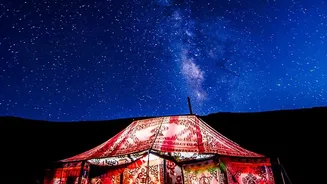
The Hanle Dark Sky Reserve is more than a scientific project; it's a powerful engine for sustainable development. The initiative has catalysed the growth of 'astro-tourism', creating new livelihoods for the local residents. Community members, many of them women, are being trained as 'astro-ambassadors' to guide tourists, operate telescopes, and share their knowledge of the cosmos. This has led to a boom in homestays, providing a direct economic benefit and encouraging young people to stay in the region rather than migrating to cities for work. Visitors get an authentic experience that combines celestial wonders with local culture, food, and traditions, ensuring that tourism enriches rather than disrupts the community.
How the Darkness is Protected
Preserving the night sky in Hanle requires a conscious, collective effort. The IIA and local authorities have worked with villagers to implement simple yet effective measures. This includes distributing special light-blocking curtains for homes and replacing conventional outdoor bulbs with downward-facing, low-impact lighting. Guidelines are in place to manage vehicle headlights within the reserve to prevent glare. The community has been provided with telescopes and training, empowering them to become active stakeholders in the project. This grassroots involvement is crucial, ensuring that the people of Hanle are not just residents of the reserve, but its proud guardians.