



A Telescope Turned Time Machine
When we gaze at the night sky, we are looking into the past. Because light takes time to travel, the stars and galaxies we see are not as they are now, but as they were when their light began its long journey to Earth. Telescopes like the James Webb Space
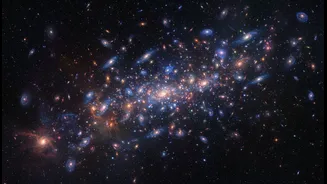
Telescope (JWST) are powerful enough to capture light from the universe's infancy, just a few hundred million years after the Big Bang. This allows astronomers to see what galaxies looked like over 13 billion years ago. What they're observing are small, chaotic, and furiously forming stars. These early galaxies are the building blocks of everything that came after, including our own galactic home. By studying these cosmic ancestors, scientists can test theories about how massive, structured galaxies like the Milky Way came to be.
A History of Cosmic Cannibalism
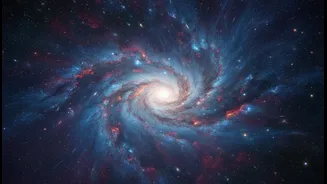
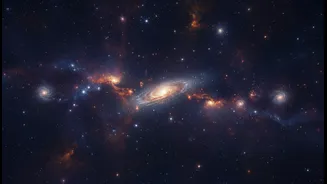
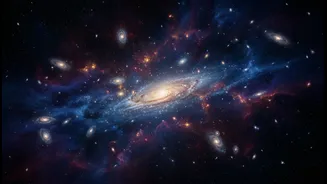
The prevailing theory of galaxy formation is a violent one, built on a history of mergers and acquisitions. All large galaxies, including the Milky Way, are believed to have started as small clumps of dark matter, gas, and stars. Gravity pulled these smaller structures together, causing them to collide and merge over billions of years. This process of 'galactic cannibalism' is how our galaxy grew to its current size, accumulating more than one hundred billion stars. When a smaller galaxy is pulled in by the Milky Way's immense gravity, it gets torn apart, its stars pulled into long streams that wrap around our galaxy. These stellar streams, which can still be detected today, are the fossilised remnants of our galaxy's past meals, giving astronomers crucial clues about the galaxies that were consumed long ago.
The Milky Way's Turbulent Youth
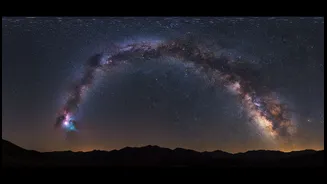
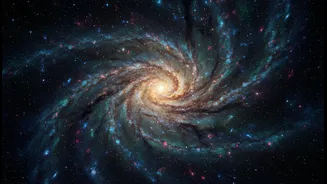
Recent discoveries are showing just how early this process started. Astronomers have found that galaxies in the early universe were developing complex structures, like central disks and bar-like shapes, much sooner than previously thought. These bars act like cosmic conveyor belts, funnelling gas and stars toward the galactic centre and accelerating growth. Observations of these distant galaxies mirror what scientists believe happened during our own galaxy’s youth. Around 10 billion years ago, the Milky Way is thought to have had a massive collision with another galaxy, an event that helped form our galaxy’s inner halo and thick disk. The discovery of ancient stars within the Milky Way's disk, where they weren't expected to be, challenges some old assumptions and suggests our galaxy's formation was a dramatic and complex affair.
Putting the Pieces Together
By comparing the 'baby pictures' of ancient galaxies with the 'fossils' found within our own, astronomers are constructing a family tree for the Milky Way. The chemical composition of old stars, for example, tells a story about the environment in which they formed. Early stars are poor in heavy elements (which astronomers call 'metals'), while younger stars are richer in them, because these elements are created inside stars and spread through supernova explosions over cosmic time. Studying the chemical makeup and movements of stars allows scientists to identify distinct populations that likely came from different consumed galaxies. Each new discovery, whether it’s an ultra-massive galaxy in the early universe or a stream of ancient stars in our own backyard, adds another piece to the puzzle of our cosmic origins.