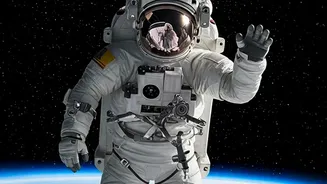







More Than a Suit, It's a Personal Spaceship
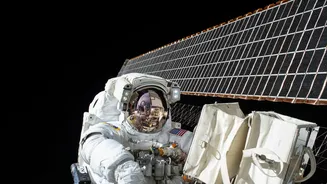
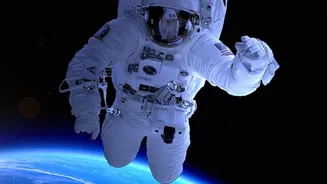
Forget thinking of a spacesuit as just a set of clothes. It's a self-contained, human-shaped spacecraft formally known as an Extravehicular Mobility Unit (EMU). Weighing over 120 kg on Earth, this complex machine provides everything an astronaut needs
to survive for hours outside their vessel. It supplies oxygen, manages carbon dioxide, maintains a stable pressure, and protects against the lethal conditions of space. Without it, a person would lose consciousness in about 15 seconds due to the vacuum. The suit is a marvel of engineering, composed of multiple distinct layers, each with a critical job to do.
The Inner Layer: Personal Air Conditioning
The first thing an astronaut puts on is the Liquid Cooling and Ventilation Garment (LCVG). This is essentially a set of long underwear made of stretchy Spandex, but it is woven with approximately 91 metres of fine plastic tubing. Chilled water circulates through these tubes, pulling excess heat away from the astronaut's body to keep them cool during strenuous work. Ventilation ducts in the garment also help remove moisture from sweat, keeping the astronaut dry and comfortable during a spacewalk that can last over six hours.
The Pressure Bubble: Staying Inflated
The next two layers work together to create a pressurised bubble of pure oxygen around the astronaut. The first is the bladder layer, a urethane-coated nylon garment that is airtight, much like a balloon. This layer holds the oxygen at a pressure of about 4.3 psi, which is roughly 30% of Earth's sea-level pressure but enough to keep bodily fluids from boiling in the vacuum. Immediately on top of it is the restraint layer, made of a tough polyester like Dacron. This layer prevents the bladder from ballooning outwards and gives the suit its human shape, allowing for movement while maintaining constant pressure.
The Outer Shield: A Multi-Layered Defence
The outermost section is the Thermal Micrometeoroid Garment (TMG), which itself consists of up to nine layers. The inner part of the TMG is a thermal shield made of multiple layers of aluminised Mylar—the same material used in shiny balloons—separated by a spacer fabric. This acts like a thermos flask, insulating the astronaut from the extreme temperature swings of space, which can go from a scorching 121°C in sunlight to a freezing -157°C in shadow. The final, outermost layers are designed for toughness. They include materials like Kevlar, the same fibre used in bulletproof vests, to protect against impacts from tiny but hyper-fast micrometeoroids. The brilliant white outer fabric, a blend of Gore-Tex, Kevlar, and Nomex, resists tears and reflects the harsh heat of the sun.
The Helmet and Backpack: Life Support Central
The iconic helmet is more than just a window. It's a pressurised bubble of strong plastic with a gold-lined visor to shield the astronaut's eyes from the unfiltered glare of the sun. Attached to the back of the suit is the Primary Life Support System (PLSS), a backpack that contains the oxygen tanks, batteries for power, a fan for circulation, the water-cooling reservoir, and a system for removing exhaled carbon dioxide. Together, all these intricate parts create a personal, mobile environment that allows humans to work and explore in the deadly emptiness of space, turning science fiction into reality with every step.