



The Constant Battle Against Weeds
For any farmer, weeds are a persistent and costly enemy. They compete with crops for essential resources like water, sunlight, and soil nutrients, directly impacting the harvest's quality and quantity. For generations, the primary solutions have been
manual labour—a back-breaking and increasingly expensive task—or broad-spectrum herbicides. While effective, widespread chemical spraying raises environmental concerns and can lead to herbicide-resistant weeds, creating a tougher problem for the future. This long-standing challenge has pushed the agricultural industry to seek a smarter, more targeted solution.
Enter Edge AI: The Brain on the Bot
At the heart of this new solution are Edge AI chips. But what does that actually mean? Think of it as the difference between asking a smart assistant on your phone a question versus a calculator. The calculator computes the answer right there, on the device. That's 'Edge AI'. Cloud AI, on the other hand, is like the smart assistant: it sends your query to a massive data centre far away, processes it, and sends the answer back. In farming, sending data to the cloud takes time and requires a stable internet connection, which is often unreliable in rural areas. Edge AI solves this by putting a powerful, compact brain directly onto the agricultural robot. All the thinking happens locally, or 'on the edge' of the network.
Training a Robot to See Weeds
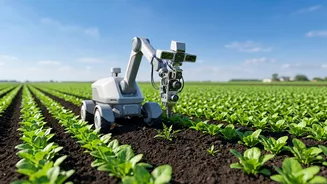
An agricultural robot's most important tool is its vision. These machines are equipped with advanced cameras that act as their eyes, constantly scanning the fields. The images are fed into the onboard Edge AI chip, which runs a sophisticated model trained to distinguish between crops and weeds. This training process involves 'showing' the AI thousands of images of different plants at various growth stages and in different lighting conditions. Using deep learning techniques, specifically convolutional neural networks, the AI learns to identify the unique shapes, textures, and colours of weeds, just as a human would learn to spot a familiar face. It can even detect them when they are tiny sprouts, closely packed with the actual crop.
From Seeing to Doing in Milliseconds
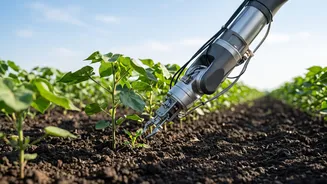
Recognising a weed is only half the job. The real magic of Edge AI is its ability to process information and trigger an action almost instantly. Because the analysis happens directly on the robot, there is virtually no delay, or latency. As the robot moves through the field, its AI model identifies a weed in the camera's view. In a split second, it commands an 'end-effector'—a tool designed for weed removal—to act. This action could be a micro-jet that sprays a tiny, precise dose of herbicide directly onto the weed, a high-powered laser that zaps it, or a mechanical tool that plucks it from the ground. This precision means that crop plants remain untouched, and herbicide use can be slashed by as much as 95%.
Why This Matters for Indian Agriculture
The implications for a country like India, with its vast agricultural sector and millions of smallholder farmers, are immense. Labour shortages in rural areas are a growing concern, and this technology offers a way to automate one of the most labour-intensive tasks. The dramatic reduction in herbicide and water usage not only cuts costs for farmers but also promotes more sustainable and environmentally-friendly farming practices. Furthermore, AI-driven precision can lead to healthier soil, better crop quality, and significantly higher yields—by some estimates, up to 30%. While the initial cost of such technology is a hurdle, its potential to boost profitability and food security makes it a critical area of innovation for the nation's agricultural future.