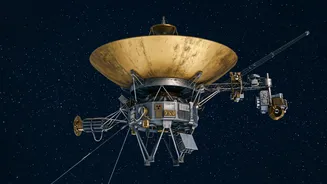




The end of the Solar System has long been a tale of two parts: the inner planets burning, the outer ones surviving. But new research suggests this cosmic story needs a rewrite, with chaos arriving far sooner than we ever imagined.
The Old Story of Our Solar System's End
For decades, the story
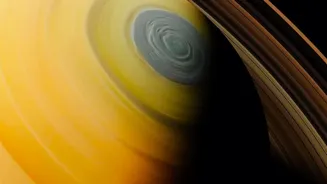
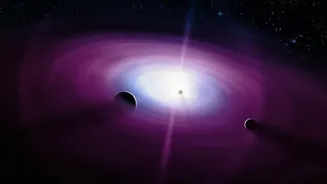
of our Solar System's distant future seemed settled. In about five billion years, our Sun will exhaust the hydrogen fuel in its core and begin to die. It will swell into a massive red giant, a phase during which it will engulf Mercury, Venus, and almost certainly Earth. After this destructive expansion, the Sun will shed its outer layers and collapse into a white dwarf — a dense, Earth-sized remnant of a star. The surviving outer planets, Jupiter, Saturn, Uranus, and Neptune, were expected to be pushed into wider, but stable, orbits by the Sun's loss of mass. Previous models predicted this new configuration could remain stable for an astonishingly long time, perhaps for a hundred billion years or even longer, only to be disrupted by a passing star.
A New Wrinkle in Time
A recent study published in The Astrophysical Journal Letters has introduced a dramatic plot twist. A team of researchers ran hundreds of complex computer simulations to model the Sun's death and its effect on the outer planets. Their findings suggest that the assumption of a long, peaceful existence for the outer planets may be wrong. The study indicates that the Solar System’s final act could be far more chaotic and begin much earlier. Instead of a stable, centuries-long decline, the new research points to a major disruption that could start even before the Sun completes its transformation into a white dwarf, cutting the previously estimated lifespan of our planetary system by billions of years.
The Great Planetary Billiards Game
The key to this new prediction lies in how the Sun loses mass. Earlier models often assumed the Sun would shed its outer layers smoothly and symmetrically. However, the new research, led by astrophysicists like Konstantin Batygin at Caltech, suggests this process will be messy. They argue the Sun will eject its mass in thousands of uneven, violent bursts, creating 'stochastic kicks' that will slightly nudge the star each time. While each individual kick is tiny, the cumulative effect over millions of years creates a 'random walk' for the Sun. This subtle movement alters its gravitational pull on the giant planets, slowly destabilising their carefully balanced orbits and turning the orderly system into a cosmic game of billiards.
A Chaotic Fate for the Gas Giants
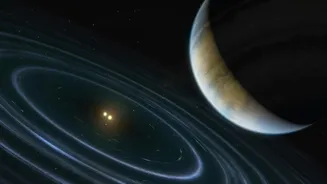
The consequences of this instability are dramatic. The simulations showed that as the orbits of the giant planets become unsettled, they begin to cross paths, leading to violent gravitational encounters. In many scenarios, this leads to entire planets being ejected from the Solar System, doomed to wander interstellar space as rogue planets. In about 40% of the simulations, this planetary scattering and disruption began while the Sun was still in its red giant phase, long before the white dwarf even formed. Across the various models, the conclusion was stark: in roughly 90% of the simulations, the outer Solar System became unstable within just three billion years of the Sun becoming a white dwarf. In some simulated futures, Uranus and Neptune switched places, while in others, Saturn was the first to be cast out into the void.